Contents
Tags

The iPhone 18 Pro Spec Apple Won't Mention On Stage
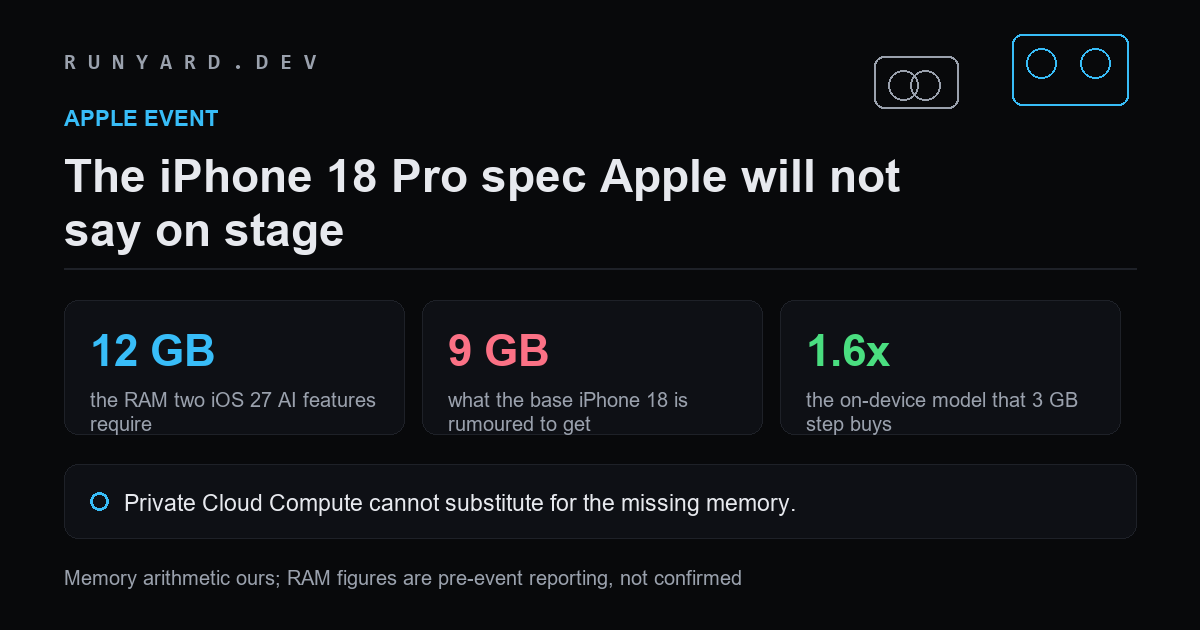
Apple's keynote is on 9 September. You will hear about the A20 Pro, the 2nm process, the neural engine and how much faster everything is. You will not hear a RAM figure, because Apple has never put one on a keynote slide.
RAM is the number that matters, and this year it is not a subtle point. Reporting ahead of the event says Apple is gating Apple Intelligence features on memory outright.
What is reported
- ▸The iPhone 18 Pro, 18 Pro Max and the foldable are each expected to carry 12 GB of RAM — the same as the 17 Pro.
- ▸Two iOS 27 on-device features — customisable Siri voice expressiveness and significantly improved dictation — are reported to require a minimum of 12 GB.
- ▸Private Cloud Compute is reported as unable to substitute. These run on-device or not at all.
- ▸The base iPhone 18, delayed to spring 2027, is expected to ship with 9 GB and therefore to miss that tier.
That last pair is the story. A cloud fallback exists for most of Apple Intelligence, and for these features it explicitly does not. Apple is saying, through its product boundaries, that some things only work if the model is resident in memory on the device.
What 12 GB actually buys
A phone does not hand its RAM to one process. iOS, the compositor and every background app take their share, so a resident model realistically gets somewhere between a quarter and a third of the total. That fraction is an assumption; the arithmetic on top of it is the same we use for every local model — parameters times bits-per-weight over eight, plus a cache term, plus runtime overhead.
- ▸A 9 GB phone, at a 25–33% share, gives a model 2.2–3.0 GB. That holds roughly a 2B to 3B model at Q4.
- ▸A 12 GB phone gives 3.0–4.0 GB. That holds roughly a 3B to 5B model.
- ▸Taking the midpoint of that range: about 2.5B against about 4B, so roughly 1.6 times the parameters.
Put another way: three extra gigabytes of RAM buys well under a gigabyte of extra model budget, and that is the entire difference between qualifying for the top tier and not. Memory on a phone is expensive in a way that is easy to miss when a desktop card carries 24 GB.
Why a faster chip does not fix this
Expect the keynote to spend real time on the A20 Pro's neural engine. It will be faster, and for on-device generation that matters less than it sounds.
Producing one token means reading every active weight once. That makes generation memory-bound rather than compute-bound — the processor spends most of its time waiting on memory, not calculating. A faster NPU shortens the part that was not the bottleneck. It helps prompt processing, image work and anything compute-heavy; it does not let a bigger model fit.
Which is why the feature gate is expressed in gigabytes rather than in TOPS. Apple knows exactly which number is binding.
The same relationship, on hardware you can actually configure.
See how bandwidth sets speed →The number to watch for
Apple will not say it, so it will come from the teardowns and the developer documentation in the days after. When it does, this is how to read it:
- ▸12 GB confirmed on all three Pro models — the reported picture holds, and the feature split between Pro and base is a memory split.
- ▸More than 12 GB on any model — genuinely bigger news than anything said on stage, because it would move the on-device ceiling up a model class.
- ▸9 GB on the base iPhone 18 — a two-tier Apple Intelligence, where the cheaper phone is permanently excluded from some features rather than just slower at them.
- ▸Any mention of unified memory bandwidth — the other half of the equation, and the one nobody publishes for phones at all.
What this means if you run models yourself
Apple has been forced into the trade every local-AI user already makes. A model that fits, doing what a small model does well, with the hard work sent elsewhere. The difference is scale: a 12 GB phone runs something in the 3B to 5B class, while a 24 GB desktop card runs a 27B needing about 18 GB, and frontier models live in datacentres.
The gap between an on-device assistant and a frontier model is not a tuning problem or a software problem. It is roughly two orders of magnitude of parameters, and it is set by how much memory the device has.
One caveat worth stating plainly: every RAM figure above is pre-event reporting rather than confirmed specification. The memory arithmetic is ours and you can check it; the specs are journalism, and Wednesday will settle them.
Update, 10 September: the number exists now
This post went up before the keynote. The event has happened, and the answer arrived by a route it did not predict — so here is the scorecard, including the part that did not hold.
- ▸Right: Apple said nothing about RAM on stage, and its published iPhone specifications still contain no memory figure. That has not changed and probably will not.
- ▸Right: 12GB is the gate. Apple's own iOS page states the requirement for customising Siri's voice as at least 12GB of unified memory, and reporting identifies that as the line separating the iPhone models that get every Siri AI feature from those that do not.
- ▸Wrong: this post said the figure would have to come from teardowns and developer documentation. It did not. Apple published the floor itself — not as a specification, but as a feature requirement, which is a route we did not anticipate and which amounts to the same disclosure.
The distinction Apple is drawing is a fine one and worth naming. It will not tell you how much memory a phone has. It will tell you how much memory a feature needs. Those two facts together give you the answer, and Apple has now supplied the second half.
A company that publishes a memory requirement has conceded the argument that capacity is what decides on-device AI. That was the point of this post, and it is now Apple's position as much as ours.
The tier structure that resulted
- ▸Every Siri AI feature: iPhone 17 Pro, 17 Pro Max, iPhone Air, and the new 18 series — the models at or above the 12GB line.
- ▸Apple Intelligence without the advanced on-device features: the full iPhone 16 line including the 16e, plus the iPhone 15 Pro and Pro Max.
- ▸iOS 27 with no Apple Intelligence at all: iPhone 15, 15 Plus, and back to the iPhone 11 and second-generation SE.
- ▸Siri AI also starts in English only, is in beta, and is not launching in the EU or China.
And the prediction that was simply wrong
For balance, our companion piece argued Apple would talk about neural-engine figures and stay quiet about memory bandwidth, which we called the number nobody publishes for phones. Apple opened with it: 50 percent more memory bandwidth than the A19 Pro, from the widest memory interface ever shipped in an iPhone.
So the record for the week is one prediction half-right by an unexpected route, and one flatly wrong. Both landed the same way in the end — with Apple making the argument we had been making, in its own words, about both halves of the memory question.
The full tier breakdown, and why the cliff sits at 12GB.
Read the 12GB piece →And the bandwidth prediction we got wrong.
Read what we got wrong →Tools
Find AI models that fit your exact hardware. Enter your specs and get a ranked list instantly.
Newsletter