Contents
Tags

Which iPhones Get Every Siri AI Feature, and Why
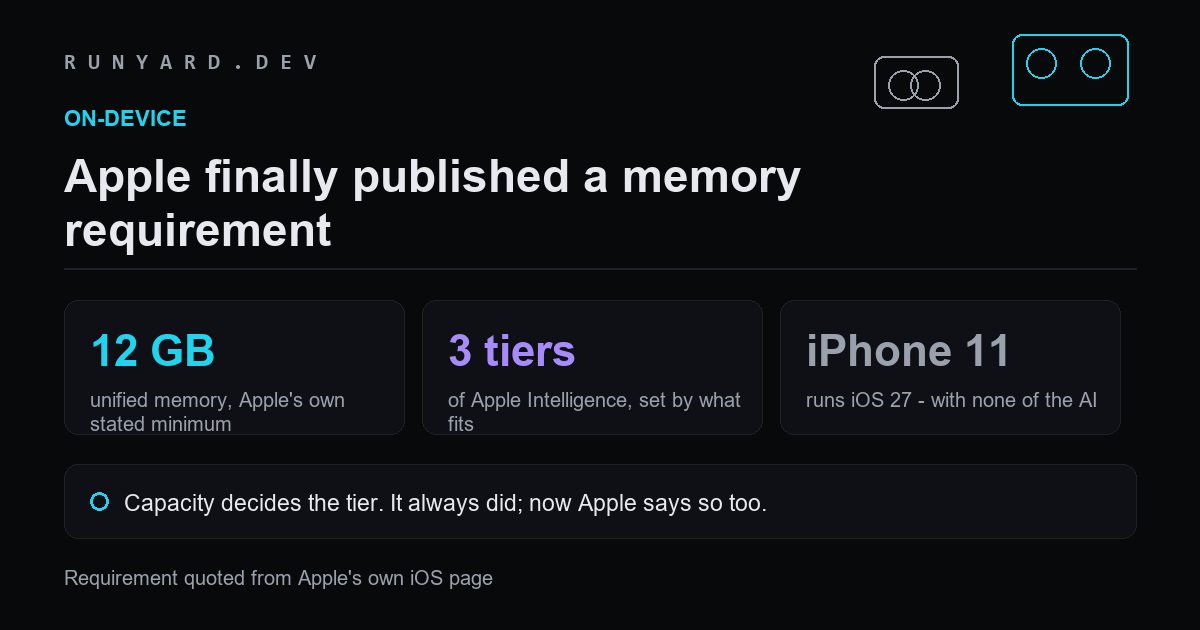
Apple has done something it has spent years refusing to do. On its own iOS page, in the requirements for customising Siri's voice, it states the condition plainly: at least 12GB of unified memory.
That is a published memory requirement, from a company that does not publish memory figures. And it explains the whole confusing three-tier mess of which iPhone gets which AI feature — because the tiers are not marketing segmentation. They are a capacity constraint with a price list attached.
The three tiers
Notice what separates tier one from tier two. It is not the chip generation, the camera, or the price. Both tiers run Apple Intelligence. Only the first runs the advanced on-device model, and the thing it needs is memory.
Why 12GB, and why a cliff rather than a slope
A model has to be entirely resident in memory to generate anything. It does not run at half speed on half the memory; it does not load. That is why hardware requirements for on-device AI are always cliffs, never slopes.
Apple's phone has to hold iOS, every running app, and the model, all in the same pool. A larger, more accurate on-device model needs more of that pool than an 8GB device can spare after everything else has taken its share. At 12GB it fits. At 8GB it does not. There is no partial credit.
This is the single most useful thing to understand about on-device AI: capacity is binary. A model either fits or it is not available to you, and no software update changes that.
It is the same reason a 12GB graphics card cannot run a model that needs 18GB, however fast the card is. Apple has simply applied the rule to phones and, unusually, told you the number.
What the top tier actually buys
Two things, per Apple: higher accuracy for speech-to-text dictation, and the ability to customise the expressiveness and pace of Siri's voice.
That is a modest return for a hardware tier, and worth being honest about. The gap between tier one and tier two is not the difference between having an assistant and not having one. Both tiers get the redesigned Siri, the photo tools, and the bulk of what Apple Intelligence does.
What the 12GB tier really signals is direction. Apple has established a memory floor and shipped a model that sits on it. The features gated behind it today are small; the features gated behind it in two years will not be.
Where the rest of the line stands
- ▸iOS 27 itself reaches back to the iPhone 11 and the second-generation SE, the same span as iOS 26 — Apple dropped nothing this year.
- ▸The iPhone 15 and 15 Plus run iOS 27 with no Apple Intelligence at all, while the 15 Pro and Pro Max get it. Same year, same name, different answer.
- ▸The full iPhone 16 line, including the 16e, sits in the middle tier.
- ▸Siri AI starts in English only, and is in beta.
- ▸It is not launching in the EU at all — that has its own explanation, and its own post.
What to do with this if you are buying
If you want every Siri AI feature today, the answer is an iPhone 17 Pro, 17 Pro Max, Air, or one of the new 18 models. If you want Apple Intelligence broadly, anything from the 15 Pro onwards does it.
If you are on an iPhone 15 or older non-Pro, no update will bring Apple Intelligence to it, and it is worth knowing that now rather than waiting for a release that cannot come.
The same line runs through iPads and Macs
Apple states the 12GB requirement in the context of its tablets and computers, where it does publish memory figures: iPad models with M4 and later, and Mac models with M3 and later. On iPhone it names models instead and leaves you to work out why those particular ones.
That is a useful tell. The requirement is not an iPhone policy, it is a property of the model Apple is shipping. The same weights need the same memory whatever the case around them is made of, which is why the line lands in the same place on three different product families.
- ▸iPad: M4 and later clears it. Earlier M-series iPads run Apple Intelligence but not the advanced on-device features.
- ▸Mac: M3 and later clears it, with the same split below.
- ▸iPhone: Apple names the models. Reporting identifies 12GB as the reason those are the models named.
- ▸Apple Watch: Series 9 and later support Apple Intelligence features, though a watch is a different order of constraint again.
Common questions this raises
Will a software update bring the advanced features to my 8GB iPhone?
No. This is the part worth being blunt about. A model that does not fit in memory cannot be made to fit by an update, and Apple would have to ship a materially smaller model to change the answer — at which point it would not be the same feature. Hardware requirements of this kind do not get relaxed.
Does more storage help?
No. Storage and memory are different things, and only memory decides what runs. A 2TB iPhone and a 256GB iPhone of the same model run identical models.
Why does the iPhone 15 Pro get Apple Intelligence when the iPhone 15 does not?
Different chips and different memory, despite the shared name and year. The Pro of that generation crossed the threshold for the base Apple Intelligence tier and the non-Pro did not. It is the clearest illustration on the whole list that the name tells you nothing and the silicon tells you everything.
Is 12GB likely to be enough in two years?
Probably not for whatever the top tier is by then, and that is the honest reading of a floor being established now. Apple has drawn a line and shipped a model that sits on it; the next model will want more. Buying at exactly the floor is buying at the bottom of the supported range.
Sourcing: device support, the English-only start, the EU exclusion and the 12GB unified-memory requirement are quoted from Apple's own iOS page. The identification of 12GB as the line separating iPhone models, and which models currently clear it, is MacRumors' reporting rather than Apple's wording — Apple names models for iPhone rather than publishing a memory figure for it.
The same capacity arithmetic, on hardware where you can check it.
Check what fits →Tools
Find AI models that fit your exact hardware. Enter your specs and get a ranked list instantly.
Newsletter