Contents
Tags
DeepSeek V4.1-Flash: 552B Parameters, 8 Doing the Work
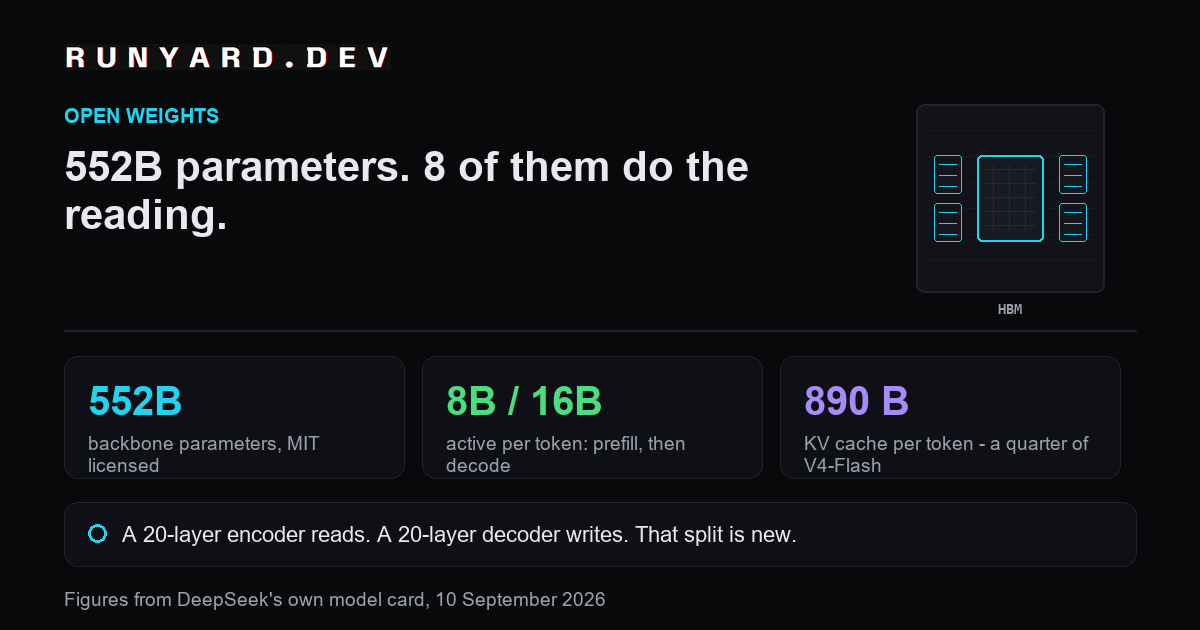
DeepSeek released V4.1-Flash today under an MIT licence, with the weights on Hugging Face. The headline figure is 552 billion parameters. The interesting figure is 8 billion — which is how many of them actually run when the model reads your prompt.
There are two genuinely new things here, and neither is the parameter count.
The spec sheet
One discrepancy worth flagging before you quote any of this. DeepSeek's own model card says 552B backbone parameters; vLLM's recipe page for the same model says 522B total. We have led with the model card because it is the primary source, but the two do not agree and we have not seen the difference explained.
New thing one: it reads and writes with different machinery
Almost every open-weight model you have used is decoder-only. One stack of layers handles your prompt and the response with the same weights doing both jobs.
V4.1-Flash splits that. Forty layers, arranged as a 20-layer causal encoder followed by a 20-layer decoder — a Causal Encoder-Decoder design. The consequence shows up directly in the activation figures: 8B parameters fire per token while reading your prompt, and 16B per token while generating the answer.
That is a deliberate asymmetry, and it is the right one. Prefill — reading the prompt — is the part that scales with how much you paste in, and it is the part that dominates cost when you are feeding a model a large codebase or a long document. Making the reading half cheaper than the writing half is a direct optimisation for long-context work.
If you routinely paste enormous prompts and get short answers back, this architecture is built for your workload specifically. If you send two lines and want an essay, you are paying the 16B rate for nearly all of it.
New thing two: the KV cache is 890 bytes a token
This is the number that should make you sit up, and it needs a little context to appreciate.
A KV cache is the running memory of a conversation — every token processed so far leaves a residue the model must keep in order to attend to it. It grows linearly with context length, and on long-context models it routinely ends up larger than the weights themselves. It is the reason your local model slows to a crawl deep into a long chat.
DeepSeek states V4.1-Flash's global KV cache footprint as 890 bytes per token, achieved with FP4 main KV caching in E2M1 format. That is roughly a four-fold reduction against V4-Flash.
Work the arithmetic on the full context and the significance is obvious. At 890 bytes per token, a completely full million-token context needs a little under 890 megabytes of KV cache. Under a gigabyte, for a million tokens.
- ▸The million-token context is not a marketing number bolted onto a model that cannot afford it. The cache maths actually supports it.
- ▸Sparse attention was trained in at a 64K sequence length rather than added afterwards, which is the other half of making long context work.
- ▸For comparison, the cache alone on many long-context models runs to tens of gigabytes at a fraction of this context length.
What 384 experts actually buys
Each MoE layer holds 1 shared expert and 384 routed ones, and exactly 6 of the routed experts fire for any given token. Six out of 384.
This is the trade every mixture-of-experts model makes, in its sharpest form yet. Capacity — the breadth of what the model knows — follows the total parameter count. Speed follows the active count. So you get the knowledge of a 552B model at roughly the compute cost of an 8B or 16B one.
What you do not get is a smaller memory requirement. All 552B parameters have to be somewhere the model can reach quickly, because any of the 384 experts might be needed for the next token. Sparsity buys speed, never capacity — and that is exactly why this is a datacentre model despite its modest active parameter count.
Where it sits against the rest of the field
- ▸Against DeepSeek's own V4-Flash: same family, roughly a quarter of the KV cache, and the new encoder-decoder split.
- ▸Against Qwen3.8-Flash-Next at 125B: V4.1-Flash is far larger in total and far sparser in activation.
- ▸Against GLM-5.3-Flash at 320B: closer in spirit, both very large MoE multimodal models.
- ▸Against anything you run at home: not comparable, and the next post covers why in detail.
The honest summary
V4.1-Flash is a long-context specialist that has been engineered around the two costs that actually bite at a million tokens: how much of the model runs while reading, and how much memory the conversation itself consumes. It attacks both, and the numbers it claims are coherent with each other.
It is also MIT licensed, which matters more than any single spec. A 552B multimodal model with a genuinely permissive licence is a meaningful thing to put into the open.
Sourcing: every figure above is from DeepSeek's own model card on Hugging Face, except the 522B alternative reading, which is vLLM's. DeepSeek has published no benchmark scores we could verify at the time of writing, so this post makes no performance claims.
What a KV cache costs on hardware you actually own.
Open the KV cache calculator →And whether any of this fits on your machine.
Read the hardware piece →Tools
Find AI models that fit your exact hardware. Enter your specs and get a ranked list instantly.
Newsletter