Contents
Tags

AlphaGenome Atlas: 9 Billion Answers, Precomputed
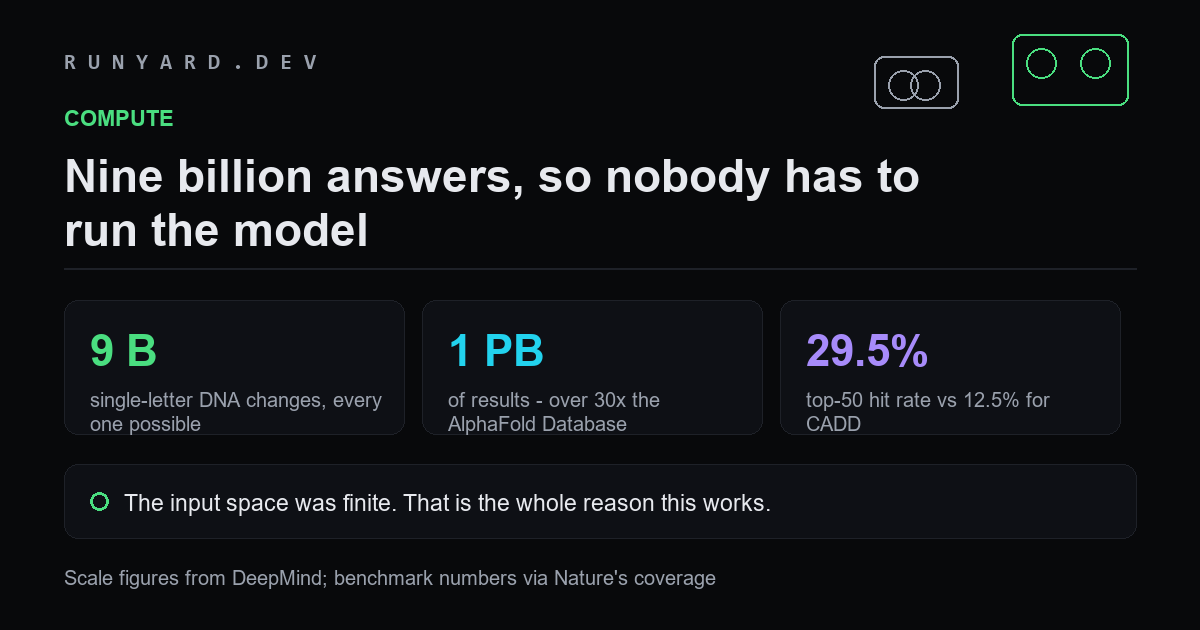
Google DeepMind has published AlphaGenome Atlas: predicted molecular effects for 9 billion single-nucleotide variants — every single-letter change it is possible to make to the human genome. Not the mutations found in people. All of them.
It is a genomics story, and this is a site about what runs on your own hardware. It is here because of how DeepMind chose to ship it, which is a third answer to a question this site asks constantly.
What was actually released
- ▸Predictions for 9 billion single-nucleotide variants, covering the whole genome rather than the roughly 2% that codes for proteins.
- ▸A dataset of about 1 petabyte — DeepMind puts it at more than 30 times the size of the AlphaFold Database.
- ▸The AlphaGenome Variant Impact score, or AVI, which merges predictions from AlphaGenome and AlphaMissense into one number per variant.
- ▸Free access through a web portal and an API for non-commercial use, with commercial access coming via Google Cloud.
- ▸A companion technical paper, and coverage in Nature.
The non-coding part is the point. Protein-coding DNA is comparatively well understood; the other 98% largely governs when and where genes switch on, and that is where disease-associated variants have been hardest to interpret. AlphaGenome could already predict those regulatory effects. The Atlas is what happens when you run that prediction everywhere in advance.
The number that matters
A ranking score is only worth something if it beats what people already use. On solved rare-disease cases from the GREGoR Consortium, the AVI score placed the known causal variant among the top 50 candidates 29.5 percent of the time. CADD, the most widely used genome-wide variant scorer, managed 12.5 percent.
Roughly double, on cases where the answer was already known. That is a real result and it is the figure to quote rather than the petabyte.
For scale on the score itself: an AVI of 10 puts a variant among the 10 percent most impactful in the genome, and an AVI of 30 puts it in the strongest one in a thousand. Those figures come from Nature's reporting on the technical paper rather than from DeepMind's own announcement.
It has already found something
Working with the GREGoR Consortium, Laura Covill and Anne O'Donnell-Luria at the Broad Institute used AVI to prioritise variants in unsolved rare-disease cases and found one affecting DNM1, a gene strongly associated with epileptic encephalopathy.
The useful part is that the prediction was mechanistic rather than a bare score. AlphaGenome indicated how the variant did its damage — it created an incorrect splice site, which led to an abnormal extension of the resulting protein. That is a specific, testable claim, and it was experimentally confirmed.
The caveat, which DeepMind states itself
The Atlas predicts biological effects. It does not demonstrate them.
A prediction that a variant disrupts gene expression or splicing tells a researcher where to look. It does not replace the experiment, and it certainly does not constitute a diagnosis — clinical work still turns on evidence from the specific patient. DeepMind says as much: the predictions are not a substitute for professional medical advice, and the Atlas has not been clinically validated.
The honest framing is that this changes the order of work, not the standard of proof. It tells you which of ten thousand candidates to test first. Something still has to be tested.
Why this is on a local-AI site
Here is the part worth your attention if you never touch a genome.
There are three ways to obtain a model's answers, and almost all discussion covers only the first two.
DeepMind took the third route at a scale nobody had attempted. Rather than shipping a model researchers must run — which would mean each lab needing the hardware, the setup and the expertise — they ran it once across the entire input space and published the answers. The model became a lookup table.
Why it worked here, and why it will not for your chatbot
The condition is that the input space has to be finite and enumerable. Nine billion is a very large number and it is still a bounded one: three billion positions, three alternative letters at each. You can list every case, and having listed them, you can compute every answer.
A language model has no such property. Its input is any sequence of tokens up to the context limit, which is not a list anybody can enumerate, let alone precompute. That is precisely why 'can my hardware run this model' is a question at all — for an unbounded input space there is no alternative to running the thing.
- ▸Enumerable input space: precompute once, then serve lookups forever. Genomic variants, chess endgames, protein structures for known sequences.
- ▸Unbounded input space: the model has to run, and someone's hardware has to hold it. Every language model you have used.
- ▸The tell is whether you could, in principle, write down every possible question. If you could, someone eventually will and will answer them all in advance.
It is the same economics as the OpenAI proof published this week: pay enormously once, then make access cheap. There the expensive half was search and the cheap half was verification. Here the expensive half is inference and the cheap half is a database query. Both are bets that compute spent once beats compute spent repeatedly.
A petabyte is not something you download
One practical note that gets lost in the headline. A 1-petabyte dataset is not a resource you host yourself — it is a service you query, through DeepMind's portal or API, under non-commercial terms, with commercial access routed through Google Cloud.
So the precomputed route trades a local compute problem for a dependency. You no longer need hardware capable of running AlphaGenome; you need continued access to somebody's servers, on their terms, at whatever those terms become. That is a familiar trade to anyone who has weighed a local model against an API, and it does not stop being a trade because the thing on the other end is a database rather than a model.
The short version
- ▸Every possible single-letter change to human DNA now has a predicted molecular effect attached to it, published and searchable.
- ▸The AVI score roughly doubles the top-50 hit rate against the standard tool on known rare-disease cases — 29.5 percent against 12.5.
- ▸It has already contributed to a real finding, in DNM1 and epileptic encephalopathy, with the mechanism predicted and then confirmed.
- ▸Predictions are not proof, and DeepMind says so plainly.
- ▸The structural lesson is precomputation: where you can enumerate every input, you can delete the question of who can run the model. Where you cannot, hardware still decides.
Sourcing: variant count, dataset size, the AlphaFold comparison, the DNM1 finding and the access terms are from DeepMind's own announcement. The AVI scale and the GREGoR benchmark figures against CADD come from Nature's coverage of the technical paper, which carries numbers the announcement does not.
For the models where hardware still decides.
Check what fits →The other compute-once bet published this week.
Read the Navier-Stokes piece →Tools
Find AI models that fit your exact hardware. Enter your specs and get a ranked list instantly.
Newsletter