Contents
Tags

Can You Run DeepSeek V4.1-Flash Locally? Not Yet
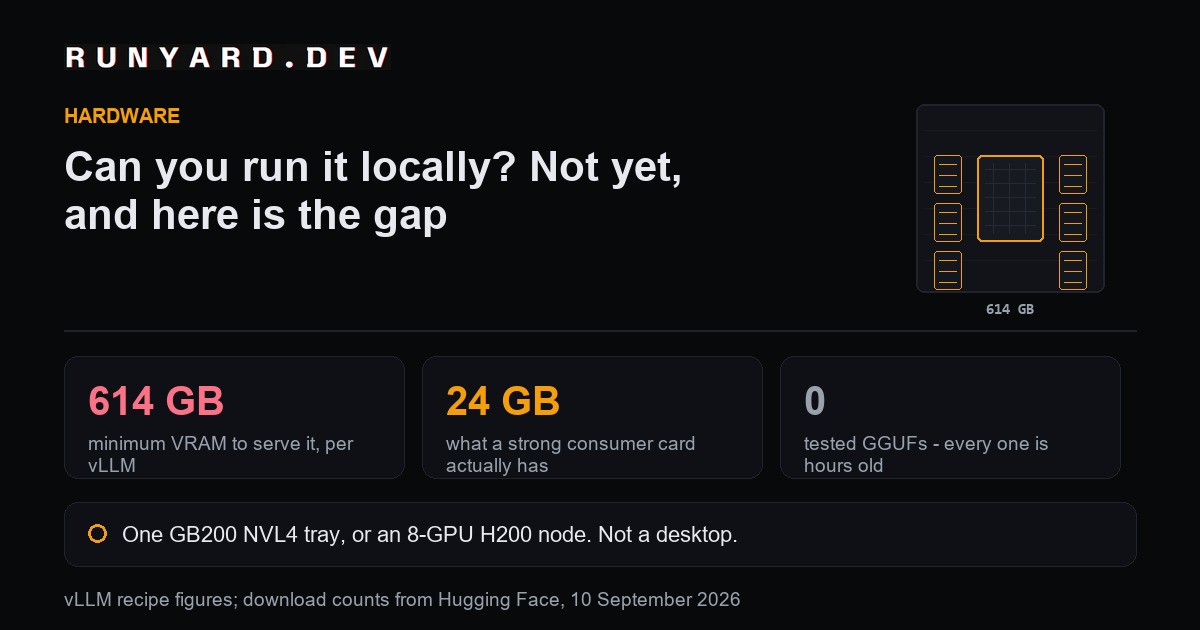
DeepSeek V4.1-Flash went up today with open weights under an MIT licence, and the obvious question for anyone who runs models at home is whether it is reachable.
The short answer is no — not today, and for most people not ever on their own hardware. That is worth saying plainly, because a lot of coverage will imply otherwise on the strength of the word 'Flash' and an 8B active parameter count.
The numbers that decide it
- ▸vLLM's recipe for the model gives a minimum of 614 GB of VRAM to serve it.
- ▸The checkpoint is roughly 511 GB on disk — 476 GiB — of which the experts are 259.5 GiB and the engram tables another 188.8 GiB.
- ▸The recipe states it fits one GB200 NVL4 tray at 768 GB using TP4, or one 8-GPU H200 node at 1128 GB with room to spare for KV cache.
- ▸Serving needs vLLM 0.30.0 or newer, via the vllm/vllm-openai:deepseekv41-flash image.
The gap is not marginal and no quantisation trick closes it on a desktop. Even a maxed-out Mac Studio, which is the most unified memory you can buy without entering the datacentre, falls short of the figure vLLM publishes.
Why 8B active does not mean 8B of memory
This is the confusion the 'Flash' naming invites, and it is worth being precise about.
Only 8 billion parameters fire per token during prefill, and 16 billion during decode. That is a genuine and large saving — on compute. It says nothing about memory, because the model routes to 6 of 384 experts per token and cannot predict which six. All of them have to be resident and reachable.
Sparsity buys speed. It never buys capacity. A mixture-of-experts model needs memory for the total parameter count and compute for the active count, and confusing the two is the most common mistake made about MoE models.
What about GGUFs? There aren't any worth using yet
You asked the natural next question, so here is the state of play as of today, 10 September 2026 — and it will change quickly.
- ▸Unsloth has no guide for V4.1-Flash. Their docs page for it returns a 404. They have a DeepSeek-V4 guide and V4-Flash GGUFs, which are a different model.
- ▸DeepSeek's own repository shows 6 downloads. The model is hours old.
- ▸Every V4.1-Flash GGUF on Hugging Face is community-built and sitting at zero downloads — an FP8 conversion, a mixed-Q2 build, and one general GGUF repo.
- ▸There are also MLX conversions for Apple silicon and NVFP4 builds, all in the same untested state.
Zero downloads means nobody has run them. Not that they are bad — that nobody yet knows. A conversion of a brand-new architecture is exactly where quantisation bugs live, and the encoder-decoder split plus FP4 KV caching is unusual enough that tooling support is a real question rather than a formality.
We are not going to publish a step-by-step guide to running something we cannot verify runs. When Unsloth or another maintainer with a track record ships tested quants, this post gets updated with real commands.
What to do instead, tonight
If what you actually want is a very capable DeepSeek model running on your own hardware, that already exists and it is the previous version.
- ▸DeepSeek V4-Flash has mature Unsloth GGUFs across the full quantisation ladder, from roughly 82 GB at the aggressive 1-bit end up to about 162 GB for the lossless 8-bit build.
- ▸The 3-bit build runs on a machine with around 110 GB of memory, which is reachable on a well-specified workstation or a large Mac.
- ▸Unsloth's lossless quant has its tensors verified bit-identical against the official checkpoint, which is the kind of diligence the V4.1 community conversions have not yet had time to receive.
- ▸It is the same family, one version behind, and it works today.
That is the honest recommendation. A model you can actually run beats a better model you cannot, every time.
When this changes
Three things would move V4.1-Flash into reach for serious home setups, and the first two are likely within weeks.
- 1.Tested GGUF quantisations from a maintainer with a track record, which typically follow a major release by days to weeks.
- 2.llama.cpp and MLX support for the encoder-decoder architecture and FP4 KV cache, which may need actual code rather than just a conversion.
- 3.An aggressive quantisation that brings a 552B model under about 150 GB, which would put it within reach of a maxed Mac Studio or a multi-GPU workstation — at a quality cost nobody has measured yet.
None of that is speculation about whether it will happen; the same sequence played out for V4-Flash. It is simply a statement that it has not happened yet, and today is day one.
Sourcing: memory and checkpoint figures are from vLLM's published recipe for the model; the architecture and active-parameter figures are from DeepSeek's model card. Download counts and the absence of an Unsloth guide were checked directly on 10 September 2026 and will date quickly.
Work out what your own memory budget actually holds.
Check what fits →The architecture, and why the KV cache is the interesting part.
Read the explainer →Tools
Find AI models that fit your exact hardware. Enter your specs and get a ranked list instantly.
Newsletter