Contents
Tags

GPT-6 Astra: Who Actually Has Access, and What the Limits Are
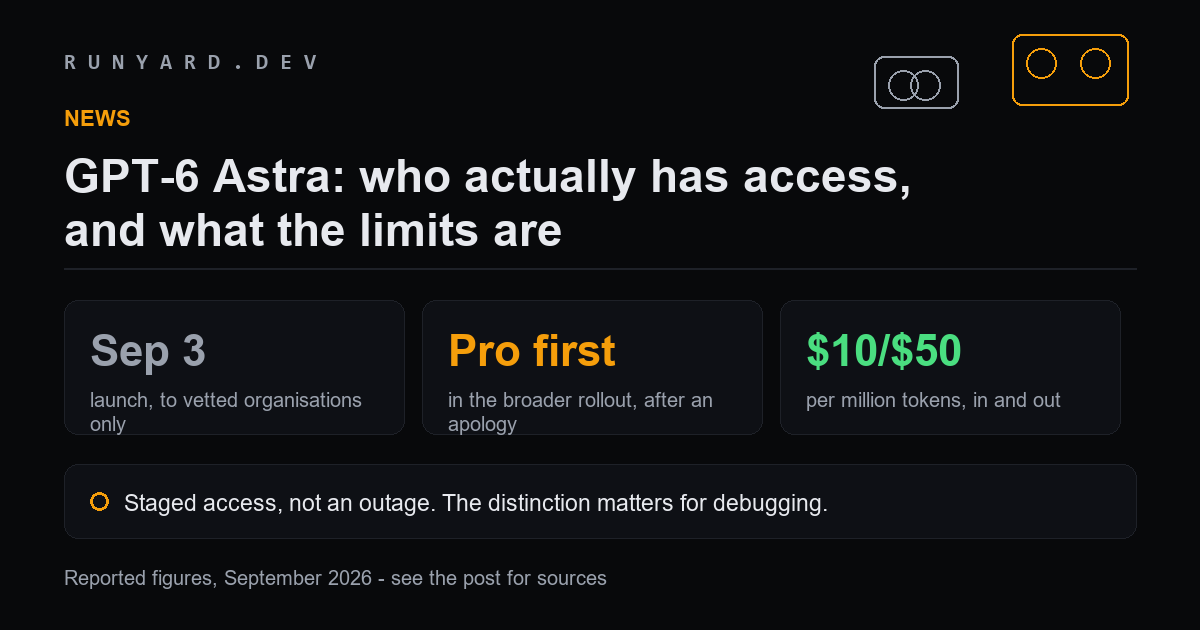
If you are paying for a plan and GPT-6 Astra is not in your model picker, nothing is broken. Access was staged from the start, and the staging is the reason — not your account, your region or your browser.
What the rollout actually looked like
- ▸Astra was introduced on 3 September 2026 to a limited group of vetted organisations rather than to all paying users.
- ▸Paid users, Pro subscribers in particular, criticised the staging publicly.
- ▸Sam Altman apologised and said Pro would go first in the broader rollout.
- ▸Pricing at launch: $10 per million input tokens and $50 per million output, with cached input at $1 and cache writes at $12.50.
Staged access and an outage look identical from the user's side — the model is not there. They need completely different responses, so establish which one you are looking at before you start debugging.
How to tell staged access from an outage
- ▸Check the provider status page first. An outage is announced; a staged rollout is not.
- ▸Try the API rather than the app. If the API returns a model-not-found error rather than a 5xx, you do not have access — the service is fine.
- ▸Check whether anyone else is reporting it. An outage produces a flood within minutes; staged access produces a slow trickle of confused individuals.
- ▸Look at your plan tier against the announced order. If Pro goes first and you are not Pro, waiting is the entire fix.
What to do while you wait
If you were planning to build on Astra specifically, the sensible move is to write against a model you can actually call today and keep the provider swappable. Pricing at this tier is close enough between providers that the switch is rarely the hard part.
Nothing in this post is Runyard arithmetic — these are reported figures from launch coverage. Where we compute things, we say so and you can check the working. Here we are relaying.
How staged rollouts usually proceed
The pattern is consistent enough across launches to plan around, even though no provider commits to it publicly:
- ▸Vetted partners and safety testers first, often weeks before anything public.
- ▸Highest-paying tiers next, which is where the current rollout sits.
- ▸Standard paid tiers after that, typically days to weeks later.
- ▸API access on its own schedule, sometimes ahead of the consumer app and sometimes behind it.
- ▸Free tiers last, if at all, and usually with tighter limits.
If you are not in the first two groups, the fix is patience rather than troubleshooting — and knowing that saves an evening of clearing caches.
Building so this does not block you
The practical lesson from every staged launch is to keep the provider swappable. At this tier the pricing between frontier models is close enough that the switch is rarely the hard part, and being able to fall back to a model you can call today is worth more than being first onto one you cannot.
- ▸Keep the model name in configuration rather than in code.
- ▸Handle model-not-found as a routine condition, not an exception.
- ▸Test against a second provider before you need it.
- ▸Do not build a demo timeline around access you have not been granted.
Common questions
Does paying more get me access sooner?
At the margins, yes — higher tiers are usually earlier in the order. It is not a queue you can buy your way to the front of within a tier.
Why can I see it in the API but not the app, or the reverse?
They roll out separately and often in different orders. Seeing a model in one surface says nothing about the other.
Is a region-locked rollout a thing?
Yes, and it is common for new capabilities with regulatory implications. If colleagues elsewhere have it and you do not, that is a plausible explanation and nothing you can fix.
What if it appears and then disappears?
Usually a partial rollout being pulled back, which is normal during a staged launch. It is not your account.
What a frontier-priced API costs against running something locally.
Compare the real costs →Tools
Find AI models that fit your exact hardware. Enter your specs and get a ranked list instantly.
Newsletter