Contents
Tags
Local LLM vs Claude, GPT and Gemini: Which API Is Worth Replacing?
We worked out what self-hosting costs against the OpenAI API. The obvious next question is what it costs against Claude, against Gemini, against everyone else — and the answer is more interesting than a list, because the brand turns out to matter far less than the tier.
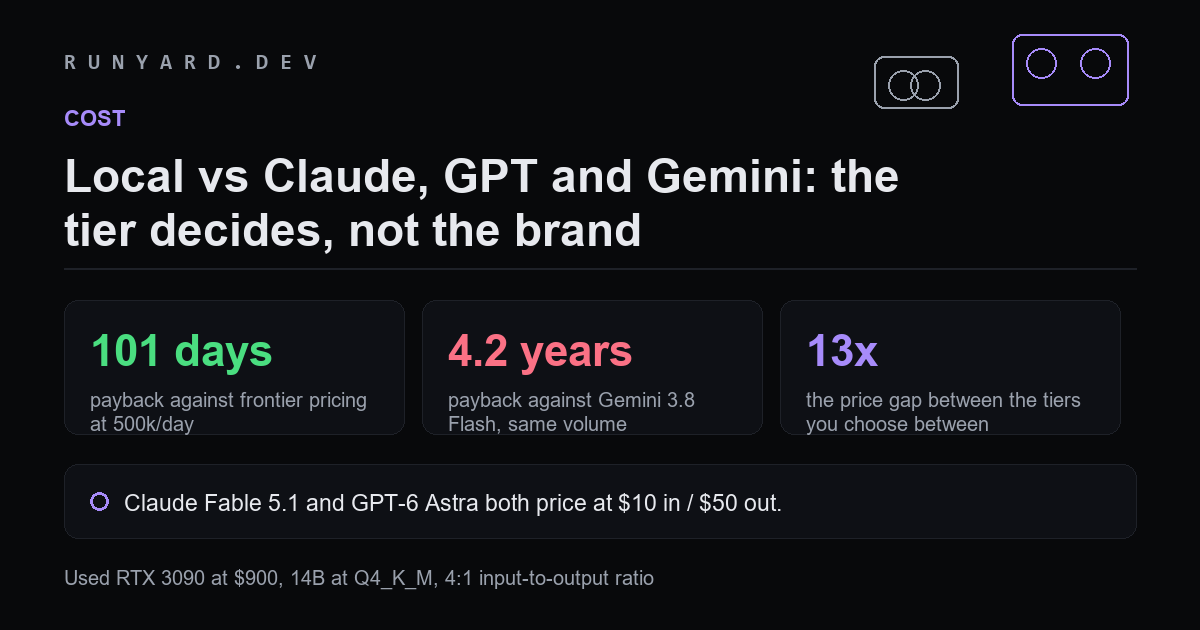
Claude Fable 5.1 and GPT-6 Astra are priced identically: $10 per million input tokens, $50 per million output. Gemini 3.8 Flash is $0.75 and $3.75. That is a thirteen-fold gap between two things people both call “the API”, and it moves the break-even from months to years.
The local baseline
Same machine as before, so the comparison is consistent: a used RTX 3090 at $900 running a 14B model at Q4_K_M. That is 24 GB at 936 GB/s, about 95 tokens per second, 350W under load, electricity at $0.18 per kWh, four-year life.
That works out at $0.184 per million tokens in electricity, and about $0.93 all-in at 10% utilisation once the card is amortised. The electricity figure is what matters for break-even, because the card price is the thing being paid back.
What each provider charges for the same work
Blended at a four-to-one input-to-output ratio, which is typical for chat and coding rather than bulk generation:
- ▸Claude Fable 5.1 — $10 in, $50 out, about $18.00 per million blended.
- ▸GPT-6 Astra — $10 in, $50 out, about $18.00 per million blended. The same number, to the cent.
- ▸Gemini 3.8 Flash — $0.75 in, $3.75 out, about $1.35 per million blended.
Anthropic's published range runs from about $1 to $50 per million depending on which model you call, and that spread is the real story. Choosing a cheaper model within one provider changes your bill more than switching provider at the same tier does.
Break-even on a $900 card
Subtracting the electricity you still pay, and dividing the card price by what you save per million tokens:
- ▸Against Claude Fable 5.1 at $18.00 per million — about 51 million tokens, which is 101 days at 500,000 tokens a day.
- ▸Against GPT-6 Astra — the same 51 million tokens, the same 101 days.
- ▸Against Gemini 3.8 Flash at $1.35 per million — about 772 million tokens, which is 4.2 years at the same volume.
Read the last line carefully, because it is the one that decides most real cases. Against the cheap fast tier, a GPU does not pay for itself within the useful life of the card. Flash-tier models are priced close to the cost of serving them, and you cannot beat a hyperscaler's amortisation with one card in a cupboard.
If you are trying to save money and you are currently on a Flash-tier model, buying hardware is the wrong move. If you are on a frontier model doing work a 14B could handle, the cheapest fix is usually a cheaper hosted model — not a GPU.
The one place the provider genuinely matters: cache pricing
Where Claude and OpenAI diverge is not the headline price but the cached read. Claude reads cached input at $0.25 per million. Astra reads it at $1.00. Four times the difference on a line item that most people never look at.
That matters more than it sounds, because of how agents work. An agent resends the whole conversation every turn, so the input side grows with the square of the turn count and quickly dominates the bill. Caching is what keeps that term in check, and the cache price is therefore the number that actually sets the cost of a long agent run.
At a 90% cache hit rate, Claude's effective input price is $1.23 per million against Astra's $1.90 — Claude is 2.1 times cheaper on input. At a 99% hit rate, which a stable system prompt and tool list can reach, it is $0.35 against $1.09, a 3.4-fold gap.
With caching on, break-even against a local card shifts too: about 167 days against Claude and 159 against Astra, up from 101 for both. Caching makes the API cheaper, which makes local hardware harder to justify — the opposite of what most self-hosting arguments assume.
Model your own turn count, prompt size and cache hit rate.
Open the agent cost calculator →So which should you use?
The honest decision tree, in the order the questions actually arrive:
- ▸Is the work sensitive, offline, or unmetered experimentation? Run locally and stop costing it. Those are the reasons local wins, and they are not financial.
- ▸Otherwise, can a Flash-tier model do the job? Use it. Nothing you can buy competes with $1.35 per million, and a card will not pay back against it.
- ▸Does the job genuinely need a frontier model? Turn caching on first — it is the single biggest lever, and on Claude it is four times more effective than on Astra.
- ▸Still spending heavily at frontier prices, on a task a 14B handles? That is the case where a $900 card pays for itself in about three months. It is a narrower case than the internet suggests.
What this does not price
Two things, and they usually decide it. Capability: a local 14B is not a substitute for a frontier model, so most of these comparisons are between different products rather than the same product at two prices. And your time: local setup and maintenance cost hours that an API call does not, which at any professional rate dwarfs the electricity.
Prices here were current in September 2026 and providers change them regularly. The arithmetic around the price is what does not go stale, which is why our calculators take the price as an input rather than baking it in.
Put your own volume, provider price and cache hit rate in.
Work out your API bill →Or start from the card and find the volume where it pays back.
Open the payback calculator →Tools
Find AI models that fit your exact hardware. Enter your specs and get a ranked list instantly.
Newsletter