Contents
Tags

Apple Put Three AI Features on a Watch. What Runs There?
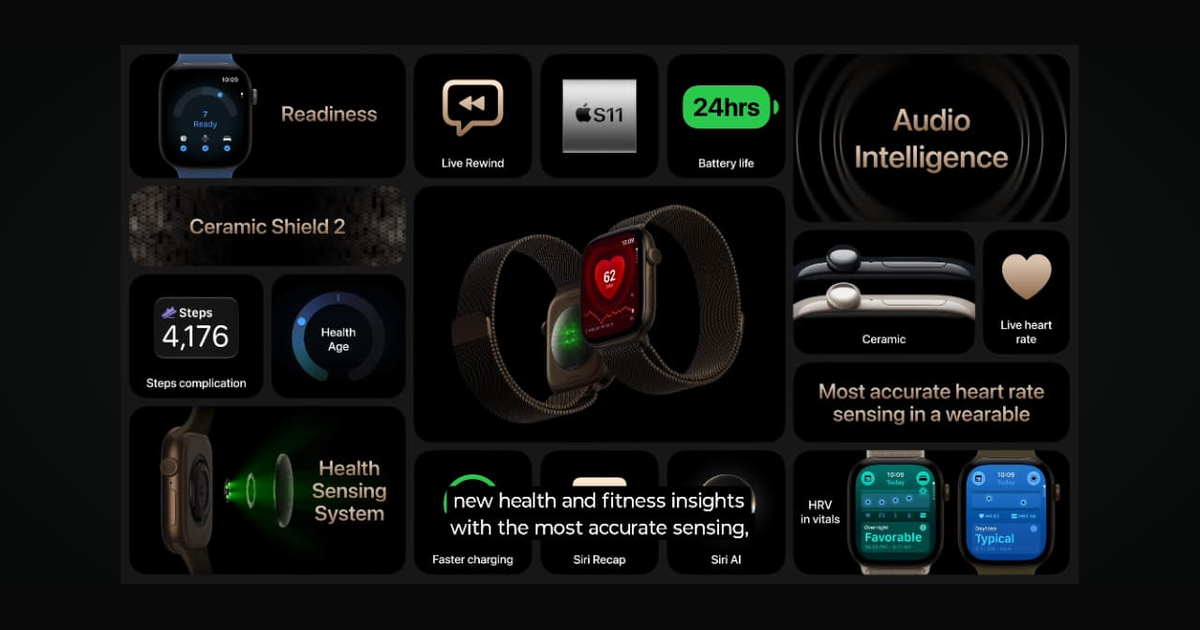
Lost under the foldable, Apple put a lot of AI on a watch tonight. The Series 12 arrives with the S11 chip, a new Health Sensing System, 24-hour battery life, and three things with AI in their name: Audio Intelligence, Siri Recap and Siri AI.
Which raises a question nobody asks about wearables: how much of that can possibly run on the watch?
The smallest on-device target that ships in volume
Run the same arithmetic we use for phones and desktops one tier further down. A watch has a fraction of a phone's memory and watchOS needs most of it, so a resident model is working with a few hundred megabytes at best:
- ▸A 0.3 GB budget holds essentially nothing above a tiny classifier.
- ▸A 0.5 GB budget holds something in the region of a 0.15B model.
- ▸A 0.8 GB budget — generous for a watch — reaches roughly 0.5B.
For scale: a phone is around the 3B mark, a 24 GB desktop card runs a 27B, and frontier models are hundreds of billions of parameters. Phone to watch is about a tenfold step down. Watch to frontier is more than three orders of magnitude.
A model that fits on a watch is not a small language model. It is a classifier, a wake-word detector, a health-signal model — genuinely useful things that are not conversational assistants.
So what is actually running where?
Apple has not said, for the watch or the phone, and the naming makes it easy to assume more than has been claimed. Three architectures are possible for anything labelled AI on a wearable:
- ▸On-watch. Realistic for wake-word detection, gesture recognition, heart-rhythm classification and the health sensing itself. These are small, specialised models and the watch is the right place for them — low latency, no radio, no data leaving the device.
- ▸Relayed to the paired iPhone. Where anything conversational most plausibly happens, using the phone's larger memory and the bandwidth Apple just improved by half.
- ▸Sent to Private Cloud Compute. Where genuinely large-model work has to go, from either device.
Siri Recap summarising your notifications is a language task. Language tasks want a language model, and a language model wants memory the watch does not have. The reasonable inference is that the watch is a sensor and an interface, and the thinking happens elsewhere.
That is not a criticism. It is the correct engineering decision. It is only a problem if the marketing invites you to believe otherwise.
The part that genuinely is on-device
The health sensing is the real on-device AI story here, and it is more impressive than a summarisation feature. Apple claims the most accurate heart rate sensing in a wearable, with HRV in vitals, a Health Age measure and a Readiness score.
Those run continuously, all day, on a battery that has to last 24 hours. That constraint — always-on inference inside a power budget measured in milliwatts — is a harder engineering problem than running a chatbot, and it is the kind of model that genuinely has to be local because it never stops.
It is also the strongest possible privacy argument for on-device processing. Continuous heart-rhythm data is about as sensitive as personal data gets, and keeping the inference on the wrist means it never needs to leave.
What to take from this if you run models yourself
- ▸The ladder is steeper than people think. Watch, phone, laptop, desktop card, datacentre — each step is roughly an order of magnitude in what fits.
- ▸Small specialised models beat large general ones under tight constraints. A 0.1B model that does one job inside a power budget is worth more on a wrist than a 3B that cannot run there.
- ▸Naming is not architecture. A feature called Intelligence tells you nothing about where it executes, and vendors rarely volunteer the answer.
- ▸Always-on changes everything. A model that runs continuously is judged on power draw rather than tokens per second, which is a different optimisation problem from the one most local-AI advice addresses.
One sourcing note. The feature names above come from the keynote slides. Apple's newsroom carries releases today for Apple Watch Series 12, Apple Watch Ultra 4 and a piece on advancing health and fitness capabilities using Apple Intelligence. Where models run is our inference from the memory arithmetic, not an Apple statement — Apple has published no memory figure for either the watch or the phone.
The same arithmetic, for hardware where you can check it.
Check what fits →And why a phone tops out around 3B.
Read the on-device memory piece →Tools
Find AI models that fit your exact hardware. Enter your specs and get a ranked list instantly.
Newsletter