Contents
Tags

Apple Does Not Need the Best Model. It Needs About 3B Parameters
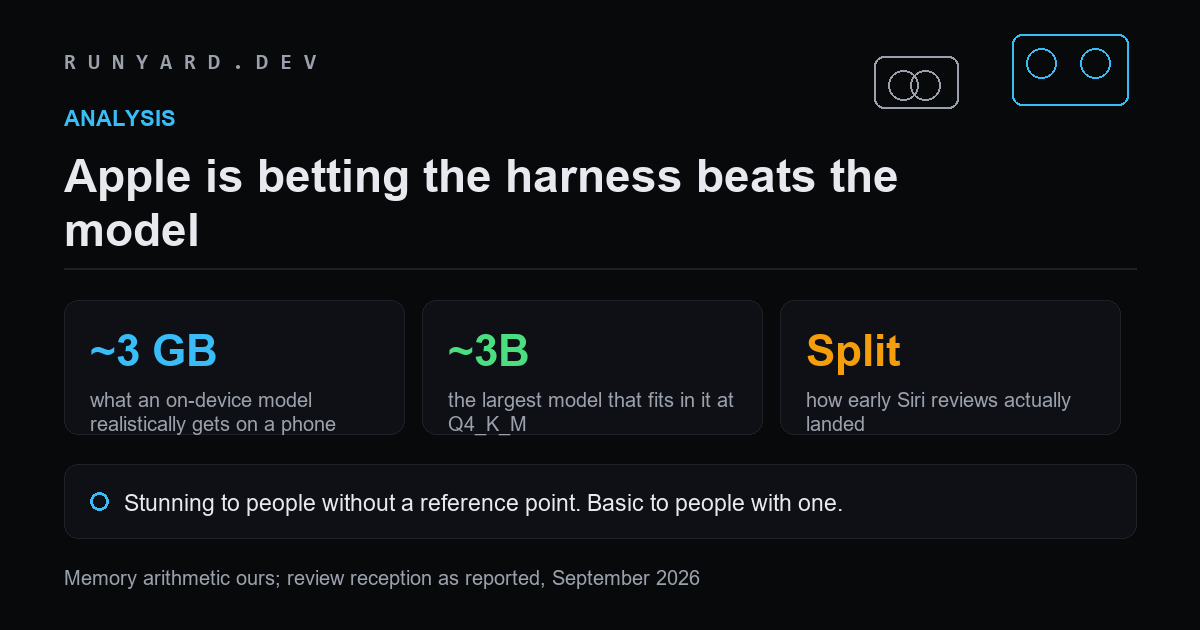
The argument for Apple goes like this. Nobody holds a lead in AI for more than a few months — Anthropic, Google and OpenAI have traded the top spot repeatedly and none has held it. A lead only counts if you can keep it. So the model is not where the durable advantage lives, and Apple does not need the best one. It needs one that is good enough, wrapped in distribution, integration and defaults that nobody else has.
It is a serious argument, and Apple has run this play before: late to music players, phones, tablets, watches, earbuds and its own silicon, and eventually leading all of them. It has also lost it — Maps, HomePod, and a car that never shipped.
There are two things worth adding, and the second one is a number.
First, the reviews are not what the hype suggests
Apple unveiled this generation of Siri in June 2026 and opened the iOS 27 public beta in July. By the end of August it was at beta 8. It is not brand new; it has been in public hands for about two months.
And the reception split cleanly in two. Users who had never adopted ChatGPT were genuinely struck — one outlet described Siri as having had a brain transplant. Users already living in ChatGPT or Gemini found it basic next to a dedicated chatbot.
That split is not a footnote. It is a natural experiment on Apple's entire thesis: a good-enough model plus deep integration is transformative to people with no reference point, and underwhelming to people who have one. Whether Apple wins depends on which group is larger — and on a billion-device install base, the first group is much larger.
Second, 'good enough' has a hard ceiling
The part missing from every version of this argument is what good enough can actually mean on a phone. That is not a matter of Apple's ambition; it is a memory budget.
A phone shares its RAM with the operating system and every running app. An on-device model realistically gets two to three gigabytes, not the whole eight. Run that through the same arithmetic we use for local models — weights are parameters times bits-per-weight divided by eight, plus a cache term and runtime overhead:
- ▸A 2 GB budget holds about a 2B model at Q4_K_M, needing 1.97 GB.
- ▸A 3 GB budget holds about a 3B model, needing 2.61 GB.
- ▸A 4 GB budget holds about a 4B model, needing 3.24 GB.
- ▸A 7B model needs 5.09 GB, which is more than a phone will give a single app.
So the on-device half of Apple Intelligence is a roughly 3B-class model, and it is being compared by users against frontier models with hundreds of billions of parameters. That is about two orders of magnitude in parameter count.
This is why anything hard routes to Private Cloud Compute, and why the on-device model handles the small, personal, latency-sensitive things. The architecture is not a compromise Apple stumbled into — it is the only shape the memory budget allows.
The same arithmetic, for whatever you want to run on your own hardware.
Check what fits →Which is exactly why the harness argument matters
If your model is two orders of magnitude smaller than the competition, the model cannot be where you win. Everything else has to be: the index of your photos and messages built on-device, the app integrations, the fact that it is already the default, and the privacy story that lets it read personal data at all.
We have now made this argument three times from three directions, which is either a strong thesis or a bias worth flagging. Coding agents: the harness was worth more than the model. GPT-6 Astra: scaffolding moved an ARC-AGI score by 37 points. And now Apple, betting a company on it.
The 37-point gap that showed how much scaffolding is worth.
Read the benchmark analysis →What would tell you the bet is working
Not benchmark scores — Apple will not publish competitive ones and does not need to. The signals that would actually indicate it:
- ▸Whether the second group converts. If people already using ChatGPT start reaching for Siri because it is there and knows their data, integration is beating capability. If they do not, Apple has won the people who were never going to switch anyway.
- ▸Whether the on-device index proves durable. Nobody else can build a cross-app personal index on iOS, and that is the one advantage no amount of model quality replaces.
- ▸Whether it ships broadly and reliably. Testers are still reporting glitches and some have rolled back to iOS 26. A default assistant that is wrong in front of a billion people is a different risk than a chatbot being wrong.
- ▸Whether Apple keeps routing the hard things to the cloud. If Private Cloud Compute is doing most of the work, the on-device story is a privacy claim rather than a technical advantage.
The honest read
Apple's bet is directionally right and it is not yet proven. Nobody has held an AI lead for long, and integration is a far more durable moat than a model that gets matched in three months. But the split reviews say the thesis works on people without a reference point and not yet on people with one, and the memory ceiling says the on-device model will stay two orders of magnitude behind the frontier for the foreseeable future.
If you run models locally, the interesting part is that Apple has been forced into the same trade you already make: a small model that fits, doing the things a small model can do well, with the hard work sent elsewhere. The difference is that Apple gets to choose the elsewhere.
Everything about Apple's roadmap here is reported rather than computed. The memory figures are ours and you can check them; the reception and the release timeline are journalism, and labelled as such.
Tools
Find AI models that fit your exact hardware. Enter your specs and get a ranked list instantly.
Newsletter