Contents
Tags

Siri AI Isn't Launching in the EU. Here's Where That Leaves You
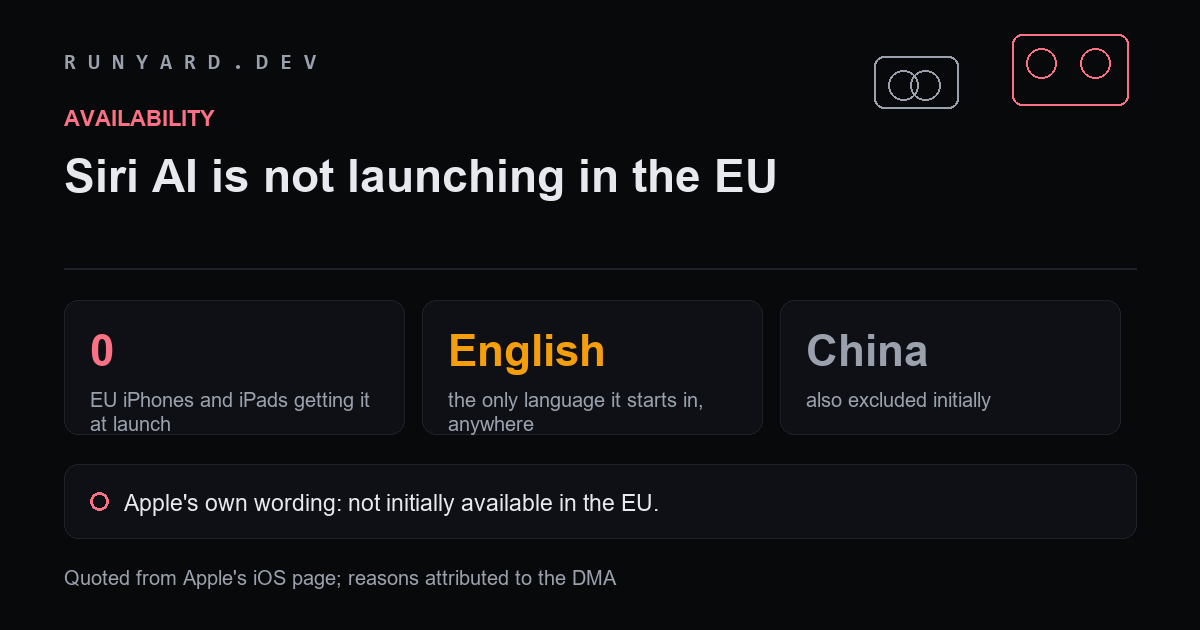
Buried in Apple's iOS page is a sentence that decides the experience for roughly 450 million people: Siri AI will not be initially available in the EU on iOS, iPadOS, and watchOS.
Not delayed on some devices. Not limited. Not available.
What exactly is affected
- ▸Siri AI on iPhone and iPad in the EU: not at launch.
- ▸watchOS is named too, so the Apple Watch features announced this month are in the same position.
- ▸China is also excluded initially, for different reasons.
- ▸Everywhere it does launch, it starts in English only, and in beta.
- ▸Apple has said 'initially', which implies a later arrival — with no date attached to it.
Why
The Digital Markets Act. The DMA imposes interoperability obligations on designated gatekeepers, and Apple has argued that shipping deeply integrated features into the EU under those obligations raises questions it has not resolved — particularly where a feature reaches across system services and third-party apps, which is precisely what a context-aware assistant does.
Whether you read that as genuine regulatory caution or as leverage in an ongoing dispute depends largely on your priors. Both readings have supporters, and the practical effect on an EU iPhone owner is identical.
What actually works instead
This is the part worth more than the explanation. If the constraint is that a cloud-connected assistant will not ship to you, the obvious answer is an assistant that does not need one.
- ▸A local model on the phone itself. Genuinely possible, genuinely limited — roughly a 3B model at the very top end. Good for drafting, summarising and rewriting; not a replacement for a full assistant.
- ▸A local model on a computer you own, reached from the phone. This is the setup that actually competes, because a desktop with a 24GB card runs a 27B model rather than a 3B one.
- ▸Third-party assistants from the App Store, which are unaffected by the Siri AI hold since they are not Apple system features.
- ▸Waiting. 'Initially' is doing real work in Apple's sentence, and the feature will most likely arrive.
There is a genuine upside here that nobody will frame as one: a local model has no regional availability, no waitlist, no language restriction and no terms of service. It runs or it does not, and that is the whole negotiation.
Does this change what iPhone to buy in the EU?
Arguably yes, and in an unexpected direction. If the flagship AI features are not available to you at launch, the case for paying the premium specifically to clear Apple's 12GB memory tier is weaker than it is elsewhere.
The hardware is still better in the ordinary ways — the cameras, the display, the bandwidth. But the AI tier you are buying access to is the one thing you cannot currently use, and it is worth pricing that honestly rather than buying on a feature list that does not apply where you live.
How much weight does 'initially' carry?
Apple has used this framing before, and the track record is mixed rather than reassuring. Features held back from the EU on regulatory grounds have generally arrived eventually, but on Apple's schedule rather than a published one, and sometimes in a reduced form that satisfies the obligation without matching what shipped elsewhere.
So the reasonable expectation is: yes, probably, at an unknown date, possibly not identical. That is not a reason to plan around, and it is certainly not a reason to pay a hardware premium today for a feature tier you cannot currently use.
What EU users still get
It is worth being precise, because 'no Siri AI' is being read as 'no AI at all' and that is not what Apple said.
- ▸iOS 27 itself ships normally, with everything that is not Siri AI.
- ▸Apple Intelligence features that are not part of the Siri AI release are a separate question from this specific hold, and Apple has shipped some EU availability previously after delays.
- ▸Every third-party AI app on the App Store is unaffected. The DMA question is about Apple's own deeply integrated system features, not about apps.
- ▸On-device models you run yourself are entirely unaffected, because there is no gatekeeper in the loop to regulate.
Should you delay an upgrade because of this?
If AI was your main reason to upgrade and you are in the EU, there is a real argument for waiting — not because the phone is worse, but because you would be paying now for the one capability you cannot exercise, and the hardware will be cheaper by the time it arrives.
If you were upgrading for the camera, the display, the battery or the build, none of that is affected and the reasoning is unchanged.
The clearest way to think about it: in the EU you are currently buying the hardware tier without the software tier. Elsewhere you are buying both. Price it accordingly.
Sourcing: device support, the English-only start, the EU exclusion and the 12GB unified-memory requirement are quoted from Apple's own iOS page. The identification of 12GB as the line separating iPhone models, and which models currently clear it, is MacRumors' reporting rather than Apple's wording — Apple names models for iPhone rather than publishing a memory figure for it.
What a model needs, wherever you happen to live.
Browse Model Radar →Tools
Find AI models that fit your exact hardware. Enter your specs and get a ranked list instantly.
Newsletter