Contents
Tags

iPhone Duo vs Galaxy Z Fold8 Ultra, Feature by Feature
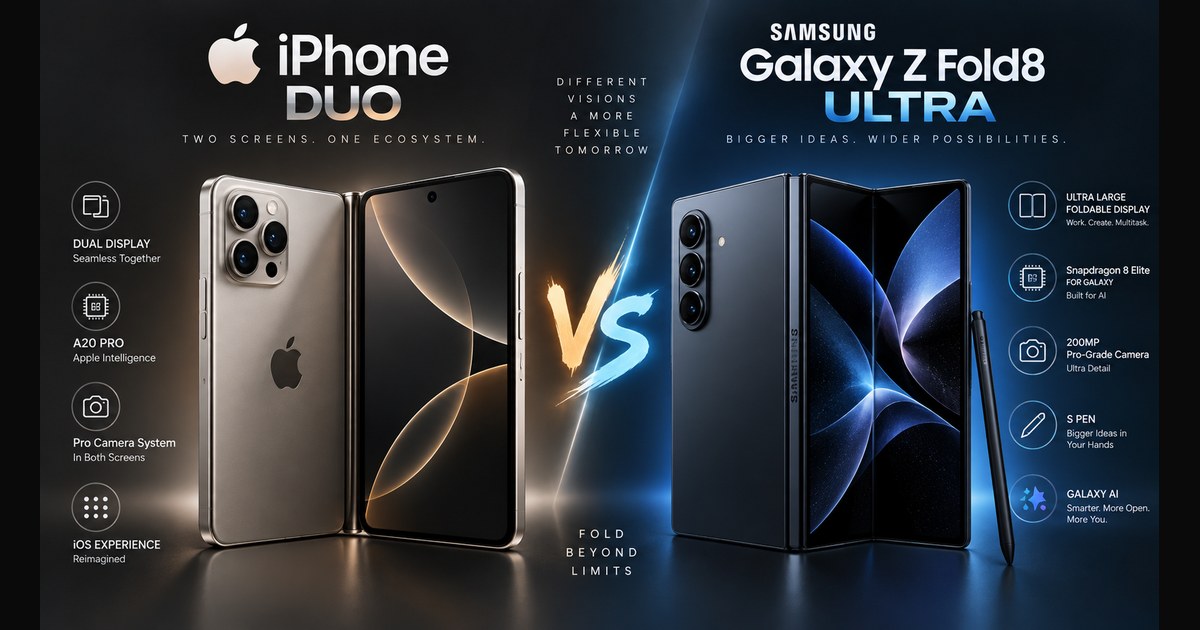
Apple's first foldable arrives eight generations into Samsung's. The iPhone Duo opens to 7.6 inches and starts at $1,999; the Galaxy Z Fold8 Ultra opens to 8.0 inches and lists at $2,099.99. They are closer in price than either company's positioning suggests, and they differ in ways the headline specs do not capture.
Here is the whole thing, line by line, followed by what each row actually means.
The displays: Samsung is bigger on both, and it matters more outside
Samsung wins both panels on size. Eight inches against 7.6 is a difference you would struggle to notice in a shop. Six and a half inches against 5.4 on the cover screen is a difference you would notice within a day.
The cover display is the one you use most on any foldable, because opening the phone is a deliberate act and most interactions are not worth it. Samsung has spent several generations widening that panel, and at 6.5 inches with a 1080 x 2520 resolution it is a normal phone. Apple's 5.4-inch panel is narrower — the company frames it as roughly 90 percent of an iPhone 18 Pro's screen area, which is a real figure and also a carefully chosen one, since area flatters a display that is smaller in the dimension that matters for typing.
Both run at up to 120 Hz and both peak at 3000 nits, so brightness and smoothness are a wash. Apple has not published a resolution for either panel, which is normal for Apple and mildly irritating in a comparison.
Ingress: the one digit almost nobody will lead with
Apple rates the Duo IP68. Samsung rates the Fold8 Ultra IP48. Those look adjacent and are not.
- ▸The second digit — 8 on both — covers water, and means immersion beyond one metre. Both phones are equally fine in the rain and in a sink.
- ▸The first digit covers solids. Samsung's 4 means protection from objects larger than 1 mm. Apple's 6 means dust-tight.
- ▸Dust in the hinge is the historical failure mode of folding phones. Grit works into the mechanism, then into the fold of the display, and the failure is gradual, expensive and not obviously anyone's fault.
If you carry your phone in a pocket with keys, in a workshop, on a building site or anywhere near sand, the gap between IP48 and IP68 is the most consequential line in the entire comparison — and it is one character long.
This is a genuine engineering achievement on Apple's part rather than a marketing line. Sealing a hinge against dust while keeping it thin is difficult, which is precisely why Samsung has not done it in eight attempts.
Cameras: Samsung has reach, Apple has consistency
Samsung brings three rear cameras: a 200-megapixel f/1.7 main, a 10-megapixel f/2.4 3x telephoto and a 50-megapixel f/1.9 ultrawide. Apple brings two: a 48-megapixel Fusion Main with an integrated optical-quality 2x, and a 48-megapixel Fusion Ultra Wide that it says is the same unit as on the iPhone 18 Pro.
- ▸Reach goes to Samsung, clearly. A dedicated 3x lens beats a 2x crop from the main sensor, and there is no arrangement of software that closes that gap.
- ▸The ultrawides are effectively level — 50MP against 48MP is not a difference you will see.
- ▸The main sensors are harder to call. 200 megapixels is a real advantage for cropping and for detail in good light; it is not automatically better in poor light, where pixel binning and processing decide the outcome.
- ▸Front cameras go to Apple on arrangement rather than specification: putting the FaceTime camera beneath the inner display leaves the big screen uninterrupted, where Samsung still has a visible 10MP cutout.
On balance: Samsung if you shoot at distance, Apple if you want two lenses that match each other and an unbroken inner display. Neither is a bad camera phone.
Size and weight, and what Apple has not told us
Samsung's numbers are public and measured: 8.9 mm folded, 4.1 mm open, 215 grams. Apple has published neither a thickness nor a weight for the Duo, and the figures circulating — around 9 mm folded, around 4.5 mm open — come from pre-launch supply-chain reporting rather than from Apple.
So the honest position is that this row cannot be compared yet. Anyone telling you tonight which of these is thinner is quoting a rumour. Reviews will settle it before the Duo ships on 23 October.
The materials are comparable in class and different in kind: grade 5 titanium and Ceramic Shield 2 against an aluminium frame with Gorilla Glass Victus 2 on the back and Victus Ceramic 3 on the cover. Titanium is stiffer for its weight, which matters on a chassis with a hinge running through it.
Chips and memory
The A20 Pro against the Snapdragon 8 Elite Gen 5 is the usual Apple-versus-Qualcomm comparison and the usual answer applies: Apple's chip leads on single-core and on sustained performance, Qualcomm's is competitive on multi-core and both are far more capable than a phone needs for anything most people do.
Memory is the asymmetry. Samsung publishes it — 12 GB on the 256 GB and 512 GB models, 16 GB on the 1 TB. Apple publishes nothing, as it never has for any iPhone. If you want to know what a device holds in memory rather than on disk, Samsung tells you and Apple makes you wait for a teardown.
Storage runs the other way. Apple goes to 2 TB, the first iPhone to do so; Samsung stops at 1 TB, with no microSD slot on either.
Battery and charging: not directly comparable, and that is Apple's doing
Samsung gives a capacity: 5000 mAh, with 45 W wired and 20 W wireless charging. Apple gives outcomes: up to 31 hours of video playback on the inner display, up to 44 on the outer, and 50 percent charge in around 20 minutes wired or 30 on MagSafe or Qi2.
You cannot convert between the two. A capacity figure says nothing about efficiency, and a playback figure says nothing about how the phone behaves under your workload. What is comparable is the charging: Samsung's 45 W is a stated ceiling, Apple's 20-minute half-charge is a stated result, and they land in broadly the same territory.
Can you write on either? No
A screen this size invites a stylus, and neither phone takes a proper one.
Samsung dropped S Pen support with the Galaxy Z Fold 7 and has not brought it back for the Fold 8 series. The reason is structural rather than commercial: the Flex Titanium layer in the display is incompatible with the EMR digitiser the S Pen needs, and the company chose a slimmer, lighter phone over stylus support. Samsung has said it is exploring the S Pen's return to future Folds, with no timeline attached.
Apple has never supported the Apple Pencil on any iPhone, and the Duo does not change that.
So a capacitive stylus works on both, on either display, without pressure sensitivity or precision. If handwriting on a folding phone is the thing you want, no current device from either company delivers it — and for Samsung that is a feature it removed rather than one it never had.
Software and multitasking
This is where Samsung's eight-generation head start is most visible. One UI has had multi-window, app pairs, a taskbar and drag-and-drop between panes for years, and third-party Android apps have had years to adapt to a square-ish display.
Apple ships Split View, which puts two apps side by side on an iPhone for the first time — including two windows of the same app. StandBy now triggers on either display, which makes the standing form factor useful, and Lock Screen controls move to the side to reclaim vertical space.
Split View is a genuinely good first implementation. It is also a first implementation, against a mature one. Expect Samsung to be more flexible and Apple to be more predictable, which is roughly the difference between the two platforms everywhere else.
AI features, briefly
Both ship a named AI suite and neither is a reason to choose between these phones. Samsung has Galaxy AI, including Now Nudge, Photo Assist and My FanCam, on top of its ProVisual Engine for low-light photography. Apple has Apple Intelligence and the new Siri.
The features overlap heavily — summarisation, photo editing, contextual suggestions — and both companies run a mixture of on-device and server processing without being especially clear about which is which.
Price and timing
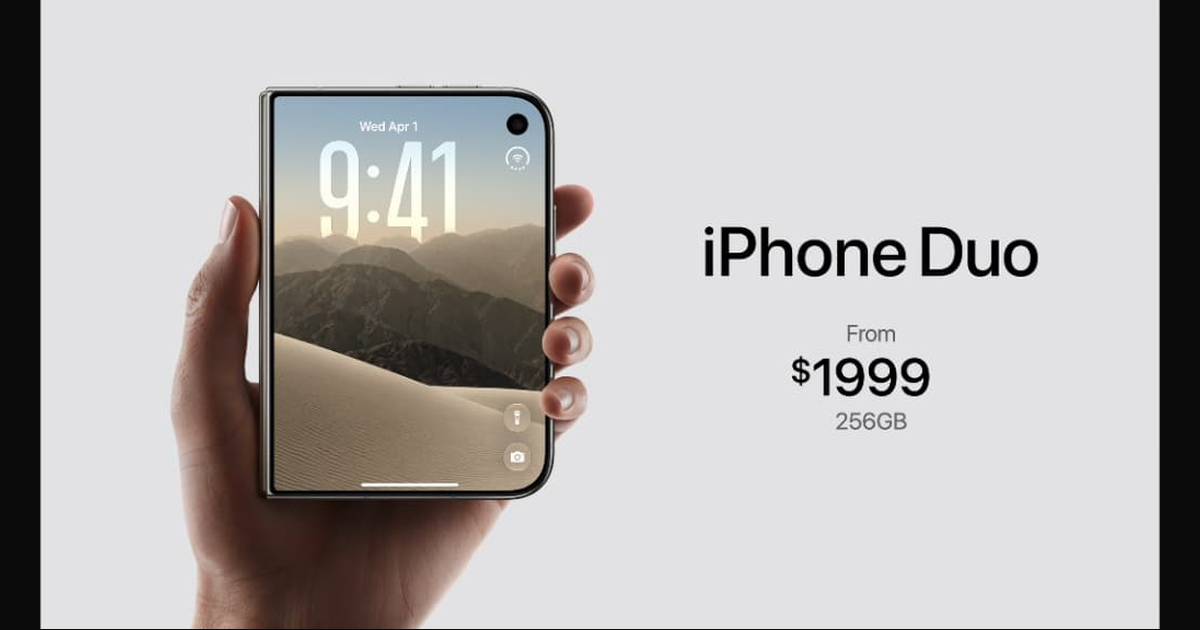
- ▸Apple: $1,999 for 256 GB, in star white and night sky. Pre-orders 16 October, on sale 23 October.
- ▸Samsung: $2,099.99 for 256 GB with 12 GB of RAM, in violet shadow, graphite, cream and a Samsung-exclusive green shadow. On sale since 22 July.
- ▸Apple is $100 cheaper at list and goes twice as high on storage.
- ▸Samsung has been shipping for nearly three months, which in practice means carrier deals, trade-in offers and retail pricing below list — none of which will exist for the Duo until well into next year.
So the $100 list gap is the smallest the real gap will be. If price is the deciding factor, the phone that has been on sale since July is the one with room to move.
Which one
Take the Galaxy Z Fold8 Ultra if you want the larger cover screen, a real telephoto lens, published memory figures, mature multi-window software and a price that has already had three months to fall.
Take the iPhone Duo if you want the dust-tight hinge, titanium, 2 TB of storage, an inner display with no camera cutout, or — most likely — because your other devices are Apple's and that is a perfectly good reason nobody needs to justify with a spec sheet.
The specification that should move you more than it will is IP68 against IP48. Everything else on this page is a preference. That one is a failure mode.
A note on the image at the top of this page. It is an illustration rather than product photography, and two details in it are wrong: it draws the iPhone Duo with a three-camera array, where the real device has two, and it shows an S Pen alongside the Galaxy Z Fold8 Ultra, which does not support one. The specifications throughout this post come from the sources below, not from that graphic.
Sourcing: the Duo figures come from Apple's newsroom release and product page. The Fold8 Ultra figures come from Samsung's US site for price, colours, memory and feature names, and from GSMArena's spec sheet for the measured values Samsung does not foreground — dimensions, weight, ingress rating, camera apertures and charging wattage. Where Apple has published nothing, this post says so rather than substituting a rumour.
Elsewhere on Runyard: what runs on the hardware you already own.
Browse Model Radar →Tools
Find AI models that fit your exact hardware. Enter your specs and get a ranked list instantly.
Newsletter