Contents
Tags

GPT-6 Astra: What Changed, and Why It Costs 2.5x
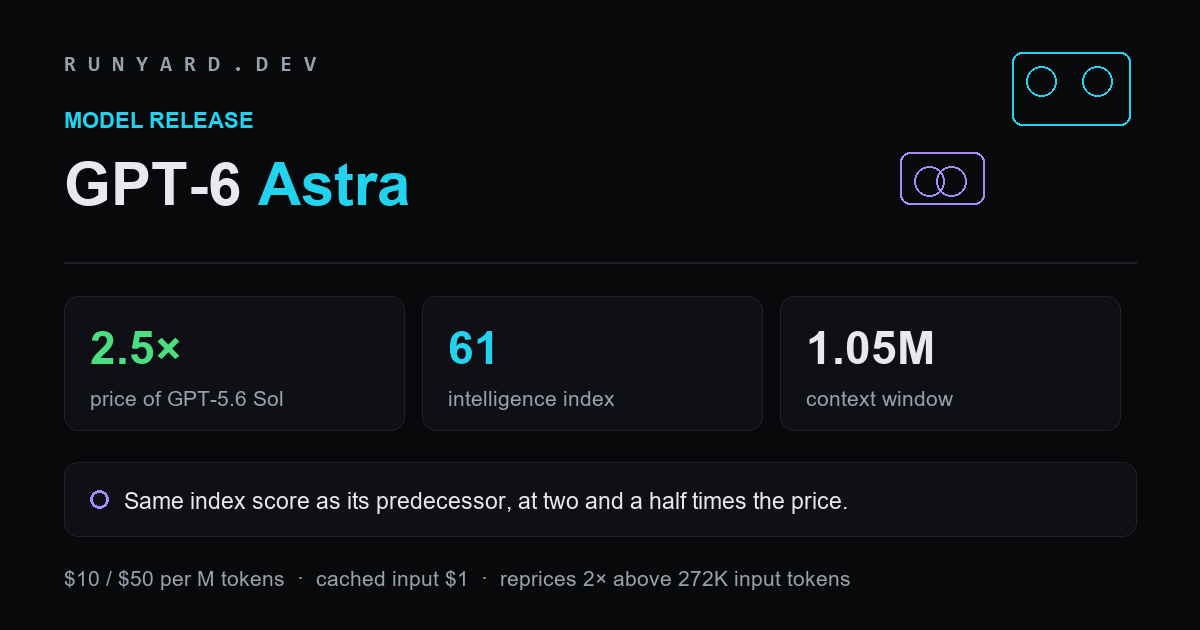
OpenAI shipped GPT-6 Astra on 3 September 2026, and the headline number is not a benchmark. It is the price: $10 per million input tokens and $50 per million output, a 2.5× rise over GPT-5.6 Sol. On Artificial Analysis's Intelligence Index the new model scores 61 — exactly what its predecessor scored. Astra earns that price somewhere else entirely, and the place it earns it is worth understanding before you migrate anything.
What OpenAI actually shipped
Astra is positioned for complex, long-running work: coding, research, computer use and multistep tasks. It carries a context window of roughly 1.05 million tokens, of which about 922,000 can be input, with 128,000 maximum output tokens. It is available on ChatGPT Plus, Pro, Business and Enterprise, through the OpenAI API, and via Amazon Web Services.
The rollout is staged rather than general. Organisations in OpenAI's application-based cybersecurity programme got access first, with broader availability following over subsequent days, and access to the most advanced capabilities is tiered. Sam Altman described the model to CNBC as a “new capability level” and said it had changed his own workflows. He also confirmed the model went through a formal review with the Trump administration before release.
The price, and what the index says about it
GPT-5.6 Sol was $4 and $20 per million tokens. Astra is $10 and $50. Cached input is $1 per million. That is a 2.5× increase on both sides of the meter, and it puts OpenAI's flagship at exactly the same list price as Claude Fable 5.1.
Against that, Artificial Analysis measures Astra at <strong>61</strong> on its Intelligence Index — equal to GPT-5.6 Sol, and five points behind Claude Fable 5.1 at max effort with fallback. On the Coding Agent Index, Astra scores 67 running in Codex, roughly level with Claude Opus 5 and Fable 5, while Fable 5.1 in Claude Code leads that index at 70. These are third-party measurements, not vendor claims, which is precisely why they are worth quoting.
Taken alone that reads as a straightforward price rise for no capability gain. It is not quite that, and the reason is the next section.
Where Astra is genuinely ahead
Three things in the launch data are real advances rather than repositioning.
- ▸<strong>Token efficiency.</strong> Artificial Analysis measures roughly a 70% improvement over its predecessor on coding tasks and around 10% on intelligence tasks. That matters more than it sounds: if a task costs 70% fewer tokens, a 2.5× price rise is close to cost-neutral on exactly the coding workloads Astra is aimed at.
- ▸<strong>Long context that actually holds.</strong> On OpenAI's MRCR v2 8-needle retrieval test, Astra scores 100% in the 256K–512K band and 96.3% from 512K to 1M. Most models with million-token windows degrade badly in the upper half; this one largely does not.
- ▸<strong>Hard agentic and reverse-engineering work.</strong> 99.9% on ARC-AGI-3, 88.0% on SRE-Bench at one attempt (reverse-engineering binaries without source), and 57.7% on Terminal-Bench 4.0, which tests agents on software engineering, system configuration and data analysis in a terminal.
The honest reading is that the Intelligence Index is a general-capability average, and Astra did not move it. What moved is the frontier of long-horizon agentic work and the cost of getting there. If your workload is one hard multi-hour task, that is the number that matters. If it is a thousand short calls, it is not.
The 272K repricing cliff
This is the detail most launch coverage skipped, and it will surprise somebody's finance team. If a request crosses <strong>272,000 input tokens</strong>, the entire request reprices at 2× input, 2× cached input and 1.5× output — not just the tokens past the threshold. The cache rate doubling matters most, because agent loops that re-read a large prefix sit above the line permanently.
So a request at 271,000 input tokens costs $2.71 of input. A request at 273,000 costs $5.46, because the whole thing is billed at $20 per million rather than $10. Crossing the line by two thousand tokens roughly doubles the bill for that call. On a model sold on its million-token window, that is a sharp edge sitting at barely a quarter of the advertised capacity.
If you are building anything that stuffs a large context, instrument your token counts and know where you sit relative to 272K. The cheapest optimisation available on Astra is often not a better prompt; it is staying under that number. We work the arithmetic through in <a href="/blog/gpt-6-astra-272k-token-cliff">the 272K token cliff</a>.
The cybersecurity story is not marketing
Astra is the first OpenAI model to reach the company's own <strong>“Critical” internal cybersecurity threshold</strong>, and OpenAI said it would limit access to those advanced capabilities accordingly. It reports Astra refusing 91.5% of requests in cyber jailbreak evaluations, against 59% for GPT-5.6 Sol.
The development history matches the framing. OpenAI paused two weeks of deployment-focused reinforcement-learning training, and reported that its largest planned frontier RL run remained on hold along with a number of Astra and cyber-related research workloads. The company said it delayed parts of the model's development to strengthen and test protections against cyber misuse before rolling out.
The launch itself was untidy — press reports appeared before OpenAI's own page was public, which is why some outlets covered it as a false start. That is a communications stumble rather than a technical one, but combined with a tiered rollout and a government review it tells you how carefully this release was being handled.
Astra against Claude Fable 5.1
They now list at identical prices, $10 and $50, which makes the comparison unusually clean. On the two independent indexes available, Fable 5.1 leads: 5 points ahead on Intelligence, and 70 against 67 on the Coding Agent Index, though the latter compares Fable in Claude Code with Astra in Codex, so it measures the harness as much as the model.
Caching is where they genuinely diverge. Fable 5.1 reads cached input at $0.25 per million; Astra charges $1. On an agent loop that re-reads a large cached prefix on every turn — which is most agent loops — that is a fourfold difference on the line item that usually dominates input cost.
- ▸Same list price: $10 input, $50 output on both.
- ▸Fable 5.1 leads both independent indexes, by 5 points and 3 points respectively.
- ▸Astra's cached input costs 4× Fable 5.1's.
- ▸Astra has the harder edge on very long context retrieval and reverse-engineering tasks.
- ▸Neither publishes weights, and neither runs on hardware you own.
What this means if you run models locally
Nothing about Astra runs on your machine, and nothing about it will. The reason it belongs on a site about local AI is the trend line: the frontier tier just repriced upward by 2.5× while its general-capability score stayed flat. Frontier capability is getting more expensive per call at the top, at the same time as open-weight models keep closing the gap on ordinary work.
That widens the case for the split most people should already be running. Keep a frontier model for the genuinely hard problems — and Astra's agentic and long-context numbers suggest it is a real option for those. Push the volume work to something you host: boilerplate, renaming across files, format conversion, first-draft tests, summarising diffs, answering questions about a codebase. That work does not need a frontier model, and on your own hardware it costs nothing per token.
OpenAI's own contribution to that half is <a href="/guide/gpt-oss.html">gpt-oss</a>, its Apache 2.0 open-weight release, whose smaller size was built to run on a single consumer card. Our <a href="/lab/openai.html">OpenAI lab page</a> tracks what the company has actually published as weights, and the <a href="/models">Model Explorer</a> takes your GPU, RAM and backend and ranks every open-weight model that fits.
Four ways to keep an Astra bill down
- ▸<strong>Stay under 272K input tokens per request.</strong> Crossing it doubles the input rate on the whole call. Chunk the work or trim the context rather than paying the cliff.
- ▸<strong>Cache aggressively, but know it costs more here.</strong> At $1 per million, cached input is a quarter of the fresh rate rather than a fortieth — useful, but not the near-free lever it is on some competitors.
- ▸<strong>Lean on the token-efficiency gain.</strong> The ~70% coding improvement is the reason the price rise may not land intact on your bill. Measure tokens per completed task, not price per million, or you will draw the wrong conclusion.
- ▸<strong>Route the easy work elsewhere.</strong> Most of what runs through a coding agent is not frontier work, and paying $50 per million output tokens for boilerplate is the single most common way these bills get large.
Should you switch?
Migrate if your workload is long-horizon agentic work, terminal-driven engineering, or retrieval across genuinely enormous contexts — those are the areas where Astra's numbers are strongest, and the 70% coding token-efficiency gain means the price rise may not reach your bill intact.
Do not migrate on the strength of the version number. The Intelligence Index did not move, the list price went up 2.5×, cached input costs four times what Anthropic charges, and there is a repricing cliff at 272K input tokens. Run your own evaluation set and measure the token counts, not just the scores. That advice is dull and it is the only thing that survives contact with a real bill.
Tell it your GPU, RAM and backend, and it ranks every open-weight model that actually fits your machine.
Open the Model Explorer → →Tools
Find AI models that fit your exact hardware. Enter your specs and get a ranked list instantly.
Newsletter