Contents
Tags
GPT-6 Astra vs Hy4 Preview: 12x Cheaper and Apache 2.0
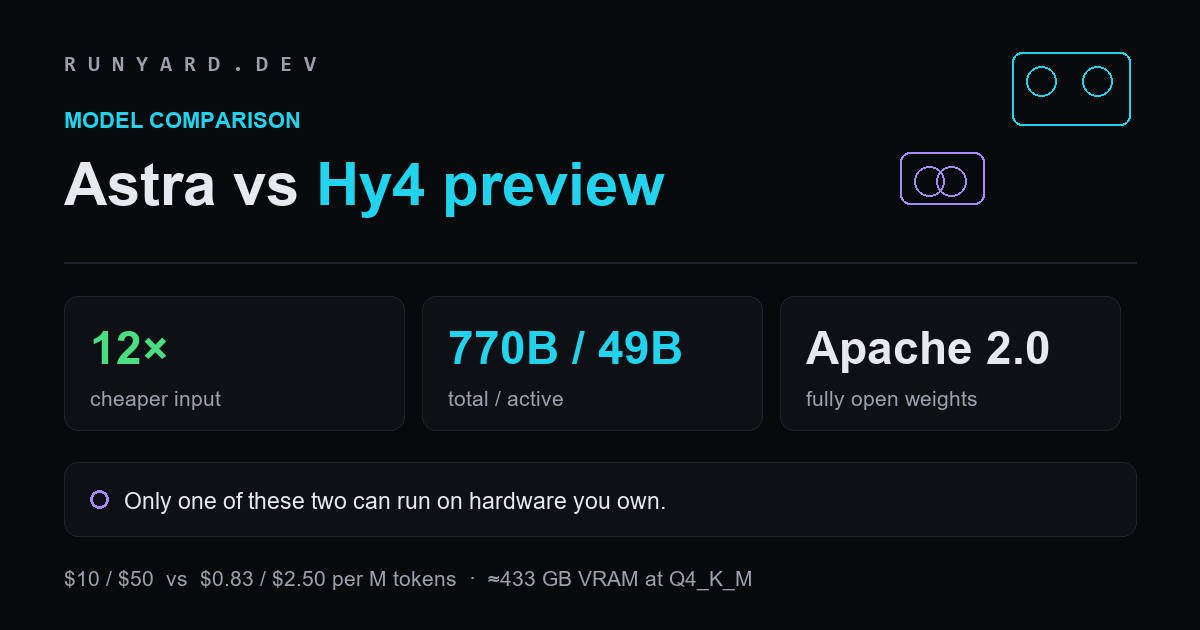
Tencent's Hy4 preview and OpenAI's GPT-6 Astra arrived within a week of each other and sit at opposite ends of the openness question. Hy4 is 770 billion parameters under Apache 2.0 with the weights downloadable today, at $0.83 per million input tokens. Astra is closed, hosted, and $10. That is a twelvefold price gap and a structural difference that no price cut could close.
Price and shape
Hy4 preview is served at $0.83 per million input tokens and $2.50 per million output. Against Astra's $10 and $50 that is roughly twelve times cheaper on input and twenty times on output. Both carry context windows near a million tokens.
Architecturally they are not comparable in public, because OpenAI publishes nothing about Astra's internals. Hy4 is documented: 78 layers, the first dense and the remaining 77 mixture-of-experts, each carrying 256 routed experts plus one shared expert with top-8 routing. That resolves 770 billion total parameters to about 49 billion active per token, using Gated DeepSeek Sparse Attention with an IndexCache for cross-layer sparse index reuse.
The benchmark asymmetry
This is where the comparison gets one-sided in an unexpected direction. Astra has published numbers and independent ones: 61 on Artificial Analysis's Intelligence Index, 67 on its Coding Agent Index in Codex, 88.0% on SRE-Bench and 57.7% on Terminal-Bench 4.0. Hy4 preview carries no Artificial Analysis intelligence, coding or agentic index at all.
That absence is not evidence of weakness, but it is a real difference in what you can know before committing. For reference, Tencent's previous Hy3 preview scored 42.2 on intelligence and 58.8 on coding — a floor rather than a prediction for a much larger model on a newer architecture. If you need numbers to justify a decision internally, only one of these two gives you any.
Total parameters fill memory; active parameters set speed
The most expensive misreading in local AI applies directly here. Hy4's router picks eight of 256 experts per token, so only about 49 billion parameters are read for any given token. But the router can pick any of them and changes its mind token by token, so every expert must already be resident. Capacity follows the 770 billion total; throughput follows the 49 billion active.
weights (GB) = parameters x bits-per-weight / 8

Hy4 preview at Q4_K_M:  770e9 x 4.5 / 8  =  ~433 GB
  ...plus KV cache, which grows linearly with context length
  ...and 49B active is what sets tokens/sec, not the 770B total
So Hy4 generates at roughly the pace of a 49B dense model while needing about 433 GB to hold at Q4_K_M. Cheap to run, expensive to house. Offloading experts to system RAM is possible and is how people fit MoE models onto smaller machines, but system memory is roughly an order of magnitude slower than VRAM, and with routing changing every token you pay that penalty constantly rather than occasionally.
The serving economics nobody quotes
Hy4's twelvefold price advantage as a hosted API and its 433 GB memory requirement are the same fact viewed from two sides. Mixture-of-experts is what makes it cheap to serve at scale: a provider holding one copy of the weights across many concurrent requests amortises that 433 GB across everybody, while each individual token only reads 49 billion parameters.
That economics works beautifully for a provider and badly for an individual. Self-hosting a MoE model for one user means paying the full memory cost to get the throughput of a much smaller model — you carry 770 billion parameters of housing to run 49 billion parameters of work. The architecture is designed for the multi-tenant case.
The practical consequence: if you want Hy4's capability, renting it at $0.83 per million input tokens is almost certainly cheaper than hosting it yourself unless you have very high sustained utilisation. Open weights are worth having for control, version pinning and fine-tuning — not automatically for cost.
What to actually test before choosing
With one model carrying independent scores and the other carrying none, a benchmark comparison will not settle this. An evaluation set will.
- ▸<strong>Completion rate on your longest task.</strong> For agentic work this dominates everything else, and it is the number neither vendor publishes for your workload.
- ▸<strong>Tokens per completed task, not per response.</strong> A verbose model that finishes is cheaper than a terse one that needs three attempts.
- ▸<strong>Behaviour at your real context length.</strong> Both advertise windows near a million tokens; advertised and usable are different numbers.
- ▸<strong>Licence fit, once.</strong> Apache 2.0 versus no weights at all is a structural decision that does not need re-testing, and for some teams it settles the question before any benchmark runs.
What Apache 2.0 actually unlocks
Commercial use, modification and redistribution, with no monthly-active-user threshold and no revenue cap of the kind several open-weight licences carry. You can pin a revision, fine-tune on your own data, and keep running it after any provider loses interest. Astra offers none of that at any price, because the weights do not exist outside OpenAI.
The practical caveat is scale. QLoRA makes fine-tuning dramatically cheaper by quantising the base model to 4-bit and training small adapters on top, but it still needs the base model resident — so fine-tuning a 770B model remains a cluster job. If training on your own data is the actual goal, a 30B-class model you can hold is a far better starting point than a 770B model you cannot.
Note also the word <em>preview</em>. Preview releases change: quantisations get revised, chat templates get corrected, serving parameters shift. Pin a revision if you build on it.
What the million-token window costs on each
Both advertise context windows near a million tokens, and on both it is a recurring charge rather than storage: input tokens are billed on every request, not kept between them. Filling a million-token window once costs about $0.83 on Hy4 preview and about $10 on Astra — each time you do it.
Astra's is worse than that comparison suggests, because of the repricing rule: any request above 272,000 input tokens is billed at double the input rate across the whole request. So a genuinely long Astra call costs $20 per million rather than $10, widening the gap against Hy4 from twelvefold to roughly twenty-four-fold on exactly the workload the million-token window is sold for.
Self-hosted, the same cost reappears as memory. KV cache grows linearly with context length and is paid in VRAM rather than dollars — at long context on a 770B model it is substantial on top of the 433 GB of weights. Whichever route you take, treat the advertised window as a ceiling to test against rather than a number to design around.
A note on what “preview” should change in your planning. Preview releases move: quantisations are revised, chat templates corrected, recommended serving parameters adjusted, and community tooling support arrives late for a 770B mixture-of-experts model on a novel attention design. If you are evaluating, none of that matters. If you are planning production, pin a specific revision and budget time to revisit it.
Choosing between them
- ▸Cost-sensitive and high-volume: Hy4 preview, at roughly a twelfth of the input price.
- ▸You need weights you own, can fine-tune and can redistribute: only Hy4 qualifies.
- ▸You need published evidence before committing: only Astra has independent index scores.
- ▸Long autonomous agent runs: Astra has the measured results; Hy4 has none either way.
- ▸You need it on hardware you already own: neither — 433 GB is not a desktop number.
Our <a href="/models">Model Explorer</a> sizes any open-weight model against your machine, and our <a href="/blog/fable-5-1-vs-hy4-preview">Hy4 against Claude Fable 5.1</a> covers the other frontier comparison at the same price tier.
The bottom line
These two are answering different questions. Astra is the better-evidenced model: it has independent index scores, published agentic results and a known long-context profile. Hy4 preview is the one you can own, under a licence that permits essentially anything, at a twelfth of the input price.
If you need proof before committing, Astra is the only one that offers any. If you need control — version pinning, fine-tuning, freedom from a single vendor's roadmap — Hy4 is the only one that offers that, and no amount of benchmarking changes it. Neither, though, runs on hardware most people own, which makes the more useful question for most readers not which of these to pick but whether the work needs either.
Tell it your GPU, RAM and backend, and it ranks every open-weight model that actually fits your machine.
Open the Model Explorer → →Tools
Find AI models that fit your exact hardware. Enter your specs and get a ranked list instantly.
Newsletter