Contents
Tags

GPT-6 Astra vs GLM-5.3: A 7x Price Gap for 1.5 Index Points
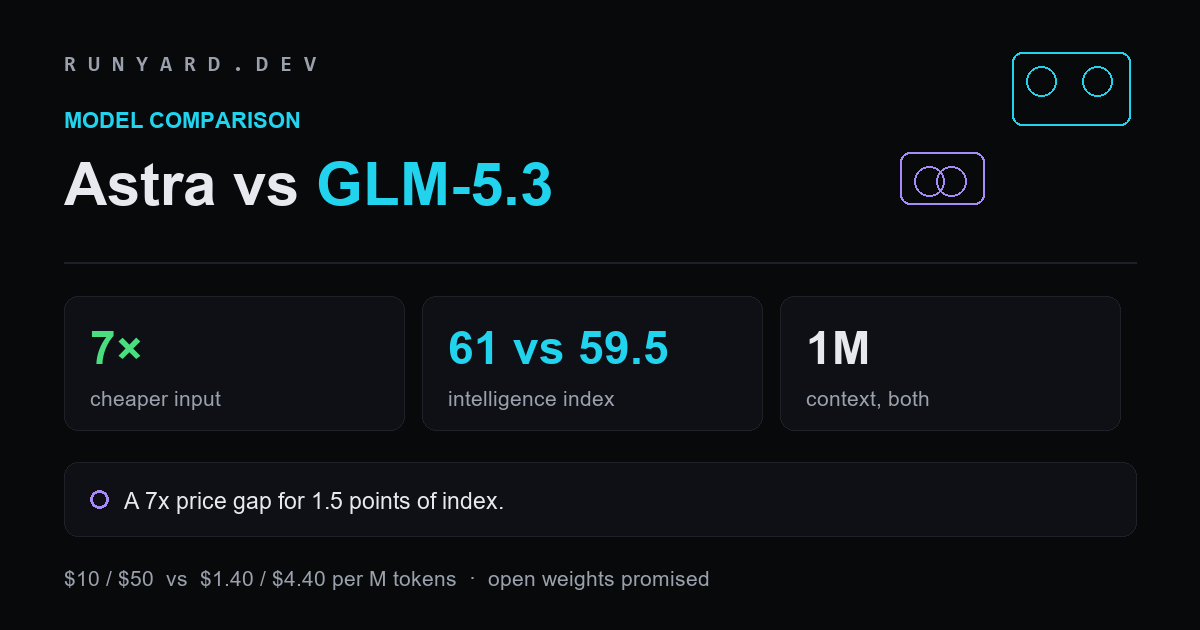
GPT-6 Astra costs $10 per million input tokens and scores 61 on Artificial Analysis's Intelligence Index. GLM-5.3 costs $1.40 and scores 59.5. That is roughly seven times the price for one and a half points, which is either the best argument for the mid-tier you will read this month or a badly framed comparison — and which one depends entirely on what you are doing with it.
The numbers
Z.ai serves GLM-5.3 at $1.40 per million input tokens and $4.40 per million output, with cached input at $0.26. Through OpenRouter it lands lower still, around $1.15 and $3.50. Against Astra's $10 and $50, that is roughly seven times cheaper on input and eleven times on output.
Both carry a 1 million-token context window with 128,000 maximum output tokens. On the Intelligence Index the gap is 61 to 59.5. GLM-5.3 also posts a coding index of 74.8 and 91.7% on GPQA Diamond, which is a strong scientific-reasoning result for a model at this price.
What GLM-5.3 actually is
Worth knowing, because it explains the value: GLM-5.3 reuses the GLM-5.2 base model unchanged and takes every reported gain from post-training alone. No new pre-training run. That is a large part of why it can be served this cheaply, and it is also a reason to treat its ceiling as lower than a model built from scratch at frontier scale.
Z.ai has also said it intends to release open weights roughly two weeks after launch, once safety evaluation and hardening are complete. If that holds, GLM-5.3 becomes something Astra structurally cannot be: a model you can host yourself, pin a version of, and fine-tune. Treat a promised release as a promise until the files appear.
One caveat on the pricing comparison: GLM-5.3's rates differ by provider. Z.ai's own API lists $1.40 and $4.40, while OpenRouter serves it closer to $1.15 and $3.50. Aggregator pricing moves, and routing through one adds a hop and a second party to your availability story. Worth checking the current rate at the provider you actually intend to use rather than the lowest figure you can find quoted anywhere.
Where the 7x premium is real
Index averages hide the shape of the difference. Astra's strongest published results are not general knowledge but long-horizon agentic work: 88.0% on SRE-Bench at one attempt, 57.7% on Terminal-Bench 4.0, and 96.3% retrieval accuracy in the 512K–1M context band. If your workload is an agent that runs for hours across a large codebase, a 1.5-point index gap understates the difference badly.
There is also token efficiency. Astra is measured at roughly 70% better than its predecessor on coding tasks, and a model that finishes in far fewer tokens narrows a price gap that looks decisive on paper. Seven times cheaper per token is not seven times cheaper per task.
Conversely, if your workload is classification, extraction, summarisation, drafting or any high-volume bounded task, the premium buys you almost nothing measurable and costs seven times as much. That is the honest split.
Where a sevenfold gap lands on a real bill
Take the same reference workload: 100 million input and 10 million output tokens a month. On Astra that is $1,000 plus $500, so $1,500. On GLM-5.3 at $1.40 and $4.40 it is $140 plus $44, so $184. Through OpenRouter's lower rates it is closer to $150.
So roughly $1,300 a month, or $15,600 a year, is what the 1.5-point index difference costs at that volume. Whether that is absurd or obviously worth it depends entirely on what the work is. For a team running bulk classification it is indefensible. For a team where one agent run produces a day of engineering output, it is a rounding error against salaries.
Caching narrows it slightly in both directions — GLM-5.3 reads cached input at $0.26 per million, Astra at $1 — but at a sevenfold base gap, caching is not what decides this.
The post-training-only question
GLM-5.3 taking its gains from post-training on an unchanged GLM-5.2 base is the most interesting technical fact about it, and it cuts both ways. It is evidence that a great deal of usable capability is still available without a new pre-training run, which is why the price can be what it is.
It also suggests a ceiling. Post-training sharpens what a base model already knows; it does not add fundamentally new capability the way scaling pre-training can. If your workload sits near the edge of what GLM-5.2 could do, GLM-5.3 will likely help. If it sits beyond that edge, a cheaper model built the same way is unlikely to close the gap, and paying for a frontier model becomes the rational move.
This is testable rather than theoretical. Run your hardest twenty tasks on both. If GLM-5.3 fails the same ones GLM-5.2 failed, you have found the ceiling.
Running it yourself
This is where the two genuinely diverge. Astra will never have public weights. GLM-5.3 is expected to. But expected weights are not the same as a model you can hold: GLM releases at this tier are large, and the flagship line has historically been server-class rather than something that fits a desktop card.
If self-hosting is the actual goal, the more useful comparison is against models sized for consumer hardware. A 32B-class coding model fits a 24 GB card at Q4_K_M with usable context; a 14B fits 16 GB. Our <a href="/models">Model Explorer</a> ranks what your specific machine holds, and the <a href="/lab/zai-org.html">Z.ai lab page</a> tracks what the company has actually published as weights rather than announced.
What a 91.7% on GPQA Diamond does and does not tell you
GLM-5.3's strongest published number is 91.7% on GPQA Diamond, a graduate-level science-questions benchmark, and it is worth being precise about what that buys. GPQA measures hard factual and scientific reasoning in a single-shot question-and-answer format. It is a genuine signal about knowledge depth.
It says almost nothing about whether a model can run a tool loop for two hours without losing the plot. Those are close to orthogonal capabilities, and the gap between them is exactly where Astra's premium lives. A model can be excellent at answering a hard question and mediocre at completing a long task, and most benchmark tables will not tell you which you are looking at.
The practical translation: if your workload is question-answering, retrieval-augmented generation, analysis or drafting, GLM-5.3's numbers describe your use case well and the sevenfold saving is close to free. If your workload is autonomous agents, they do not, and you should weight Astra's agentic results far more heavily than the 1.5-point index gap suggests.
One practical note on availability. GLM-5.3 is served by Z.ai directly and through aggregators like OpenRouter at slightly different rates, which means you can switch provider without switching model — a form of leverage that simply does not exist for a single-vendor closed model. If provider risk matters to your deployment, that is worth as much as a benchmark point or two.
The verdict
- ▸High-volume, bounded, cost-sensitive work: GLM-5.3, comfortably. The index gap will not show up in your output quality.
- ▸Long agentic runs, terminal-driven engineering, very long context: Astra, and the gap is larger than the index suggests.
- ▸You want weights you can host and fine-tune: only GLM-5.3 is even a candidate, and only if the promised release lands.
- ▸Measure cost per completed task, not per million tokens — token efficiency is where Astra claws back part of a 7x gap.
See also our <a href="/blog/gpt-6-astra-vs-glm-5-3-flash">comparison with GLM-5.3-Flash</a>, which is a different proposition again at $0.07 per million input tokens with MIT-licensed weights already published.
The bottom line
A sevenfold price gap for one and a half index points looks damning until you notice that the index is an average and the gap between these two is not evenly distributed. On question-answering, analysis and drafting, GLM-5.3 is the obvious choice and the saving is close to free. On long autonomous agent runs, Astra's published results are far enough ahead that the premium is defensible.
What makes this comparison unusually easy to resolve is that both are cheap to try. Run your twenty hardest tasks on each, count completions rather than scores, and the sevenfold difference will either look absurd or obviously worth paying. It will rarely look ambiguous.
Tell it your GPU, RAM and backend, and it ranks every open-weight model that actually fits your machine.
Open the Model Explorer → →Tools
Find AI models that fit your exact hardware. Enter your specs and get a ranked list instantly.
Newsletter