Contents
Tags

GPT-6 Astra vs Fable 5.1: Same Price, Different Winner
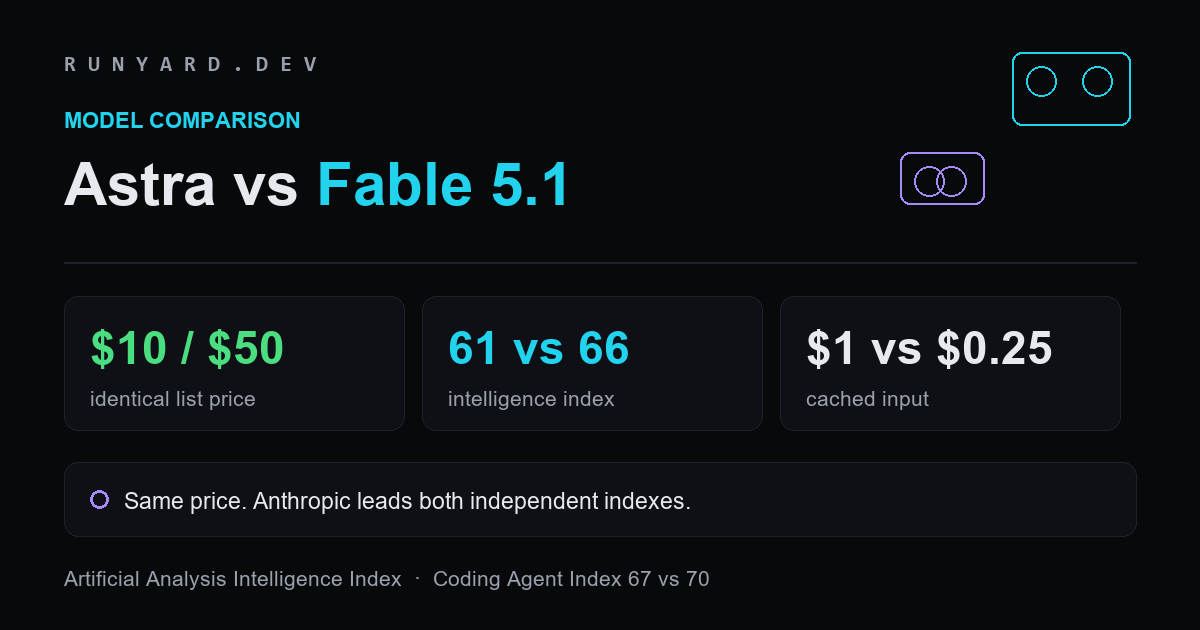
This is the rare comparison where price cancels out entirely. GPT-6 Astra and Claude Fable 5.1 both list at $10 per million input tokens and $50 per million output. Identical. That removes the usual argument and leaves a cleaner question: which one actually does the work better, and what does the independent evidence say? On both of Artificial Analysis's public indexes, the answer is Fable 5.1 — and yet there is a real case for Astra buried in how many tokens each one burns getting there.
The independent scores
Anthropic published no benchmark table for Fable 5.1 at launch and OpenAI published its own for Astra, which makes third-party measurement the only common ground. Artificial Analysis measures both.
- ▸<strong>Intelligence Index:</strong> Fable 5.1 scores 66 at max effort with default fallback — the highest published score on that index. Astra scores 61.
- ▸<strong>Coding Agent Index:</strong> Fable 5.1 running in Claude Code leads at 70. Astra in Codex scores 67, roughly level with Claude Opus 5 and the original Fable 5.
- ▸<strong>Same price:</strong> $10 input, $50 output on both.
Read carefully, the Coding Agent Index is not purely a model comparison. It measures a model inside a harness, so Fable-5.1-in-Claude-Code against Astra-in-Codex is a test of two complete systems. If you intend to use a different harness, that number transfers less cleanly than it looks.
Caching is the real cost difference
With list prices identical, the entire cost argument moves to cached input, and there the gap is wide. Fable 5.1 reads cached input at $0.25 per million tokens. Astra charges $1. That is a fourfold difference on the line item that dominates any agent that re-reads a stable prefix every turn — which is nearly all of them.
Take an agent consuming 100 million input tokens a month with 90% served from cache, plus 10 million output tokens. On Fable 5.1 that is roughly $100 of fresh input, $22 of cached reads and $500 of output: about $622. On Astra the cached reads cost $90 instead of $22, so about $690. Not enormous, but it runs the wrong way for the model that also scores lower on both indexes.
Where Astra genuinely wins
Three things, and they are not small.
- ▸<strong>Token efficiency.</strong> Artificial Analysis measures roughly a 70% improvement over Astra's predecessor on coding tasks. Fewer tokens per completed task is a cost lever that never shows up in a price-per-million table, and it is the main reason to measure cost per task rather than cost per token.
- ▸<strong>The 272K threshold, in Astra's favour and against it.</strong> Astra reprices entire requests at 2× input above 272,000 input tokens. Below that line it is competitive; above it, it is the more expensive model by some distance. Fable 5.1 has no equivalent cliff.
- ▸<strong>Very long context retrieval.</strong> Astra holds 96.3% on OpenAI's MRCR v2 8-needle test in the 512K–1M band. Most million-token models fall apart in the upper half of their window.
There is also the harness question in reverse. Astra's Coding Agent Index score was measured in Codex; OpenAI has been shipping context-management features that the benchmark harnesses do not always exercise. A model's score can move several points on plumbing alone, which is a genuine caveat on a three-point gap.
What a month actually costs on each
Prices being identical, the only way the bill differs is through caching and token counts. Take an agent doing 500 runs a month at 200,000 input and 20,000 output tokens per run: 100 million input, 10 million output.
- ▸<strong>No caching, either model:</strong> $1,000 input plus $500 output, so $1,500. Identical, because the list prices are identical.
- ▸<strong>90% cached, Fable 5.1:</strong> 10M fresh at $10 is $100, 90M cached at $0.25 is $22.50, output $500. About $622.
- ▸<strong>90% cached, Astra:</strong> the same $100 of fresh input, but 90M cached at $1 is $90, output $500. About $690.
- ▸<strong>Astra with 70% fewer coding tokens:</strong> if the token-efficiency gain applies to your workload, Astra's output side can fall well below Fable's, which inverts the result. This is why cost per task beats cost per token.
The lesson is not that one is cheaper. It is that on identically priced models the winner is decided by your cache hit rate and your tokens per completed task, neither of which appears on a pricing page. Instrument both before choosing.
What the indexes do not measure
Both scores quoted here are composites, and composites hide shape. Artificial Analysis's Intelligence Index is a weighted average across nine evaluations grouped into four categories — agents, coding, general capability and scientific reasoning — each contributing a quarter. A five-point lead on that average does not mean a five-point lead on your particular task, and Artificial Analysis says as much: individual benchmark results may be more relevant for specific use cases.
So a model can lead the composite while losing the one component you care about. If your work is scientific reasoning, look at the scientific-reasoning components rather than the headline. If it is agentic, look at the agent components and at which harness they were measured in. We pull that apart in <a href="/blog/fable-5-1-is-it-really-that-good">this piece on what a number-one ranking actually means</a>.
One more asymmetry worth naming: OpenAI publishes a great deal about Astra's evaluation results and almost nothing about its architecture, while Anthropic published neither for Fable 5.1 at launch. Neither company tells you parameter counts, context handling internals or how effort maps to compute. You are comparing two black boxes on outputs alone, which is precisely why the independent indexes carry disproportionate weight here.
Neither of these runs on your machine
Both are closed-weight hosted models, and no amount of VRAM changes that. The reason it matters here is that these two are now the joint most expensive mainstream option at $50 per million output tokens, and a large share of what people push through them is not frontier work at all.
Boilerplate, renaming across files, format conversion, first-draft tests, summarising a diff, answering questions about a codebase — a 14B or 32B open-weight model handles that acceptably on hardware you already own, at no cost per token. Our <a href="/models">Model Explorer</a> takes your GPU and ranks what fits; the <a href="/gpu">GPU pages</a> break it down card by card.
A migration checklist, if you are moving either way
Switching between two identically priced frontier models is cheap to try and easy to get wrong. Five things are worth checking before you commit a production workload.
- ▸<strong>Re-tune effort before you re-tune model.</strong> Both models expose reasoning effort, and both default high. A large share of apparent quality gaps between frontier models turns out to be an effort setting nobody adjusted.
- ▸<strong>Check your cache hit rate first.</strong> At a fourfold difference in cached-input price, this single number can decide the comparison before capability enters it.
- ▸<strong>Measure the 272K boundary.</strong> If any of your requests cross it, Astra's effective price doubles on those calls. Log your input token distribution rather than assuming it sits comfortably below.
- ▸<strong>Test in your harness, not theirs.</strong> The published Coding Agent scores compare Claude Code with Codex. If you use Cursor, Cline, Aider or your own loop, neither number describes your setup.
- ▸<strong>Keep a fallback path.</strong> Both vendors stage rollouts and both can refuse requests; a production integration that assumes one model is always available will eventually be wrong.
None of that is exciting, and all of it is cheaper than discovering the problem in production on a $50-per-million-output-tokens model.
How to choose
- ▸Cache-heavy agent loops: Fable 5.1, on the four-times-cheaper cached reads alone.
- ▸Requests reliably under 272K input tokens with heavy tool use: test Astra, and measure tokens per completed task rather than price per million.
- ▸Anything above 272K input tokens: Fable 5.1, because Astra doubles its input rate there.
- ▸Hard reasoning where the index gap matters: Fable 5.1 leads by five points.
- ▸High-volume routine work: neither — run it locally and keep the frontier model for the problems that need one.
For the wider picture on each, see our <a href="/blog/gpt-6-astra-what-changed">breakdown of the Astra release</a> and <a href="/blog/fable-5-1-is-it-really-that-good">what Fable 5.1's number-one ranking actually means</a>.
The bottom line
Two models at an identical price, where the independent evidence favours one and the efficiency argument favours the other. Fable 5.1 leads both public indexes and reads cached input at a quarter of Astra's rate, which makes it the default for cache-heavy agent work and for anything crossing 272,000 input tokens. Astra earns its place on token efficiency and on very long context retrieval, and it earns it per task rather than per token.
The decision is therefore not really about which model is smarter. It is about which of your own numbers — cache hit rate, tokens per completed task, input length distribution — you have actually measured. Teams that measure those three tend to find the answer obvious, and it is not always the same answer for every workload they run.
Tell it your GPU, RAM and backend, and it ranks every open-weight model that actually fits your machine.
Open the Model Explorer → →Tools
Find AI models that fit your exact hardware. Enter your specs and get a ranked list instantly.
Newsletter