Contents
Tags

GPT-6 Astra Not Showing Up? Four Reasons, and When You Get It
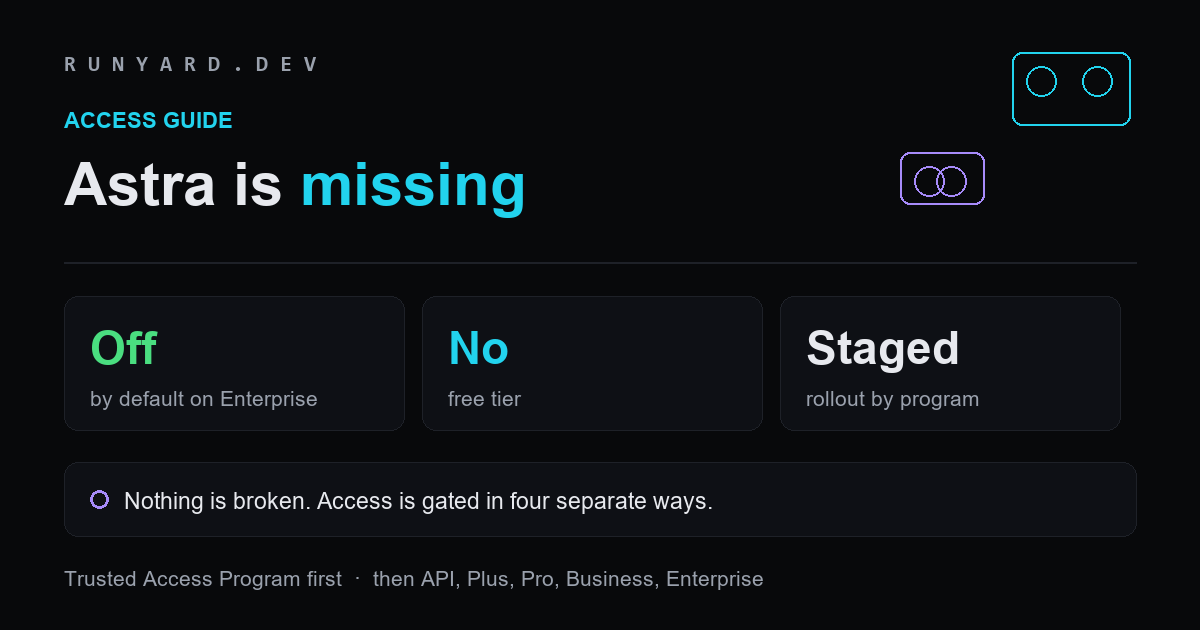
If GPT-6 Astra is not in your model picker, nothing is broken and you are not doing anything wrong. Astra did not launch generally: it is gated in four separate ways at once, and at least one of them is a setting somebody else controls. Here is each gate, how to check which one is holding you up, and what the published sources actually say — including where they disagree.
Gate 1: the rollout started with a program, not with everyone
OpenAI's own API documentation states that Astra began rolling out to enterprises in its <strong>Trusted Access Program</strong>, with access through the API and the Plus, Pro, Business and Enterprise plans arriving “in the coming days”. Some launch coverage refers instead to a <strong>Daybreak</strong> access program for the earliest organisations.
Whichever name applies to a given cohort, the practical point is the same: day-one access was granted to a limited set of organisations that had applied for it, and general availability followed on a schedule OpenAI did not publish precisely. If you are not in one of those programs, waiting is the intended experience.
Gate 2: your Enterprise or Business admin has to switch it on
This is the one that generates support tickets, because it looks identical to not having access at all. On Enterprise workspaces, Astra is reported to be <strong>off by default</strong>: an administrator must enable it for the workspace before anyone in it sees the model.
So if you are on a company account and a colleague at another company already has Astra, that tells you nothing about your own situation. The correct next step is not to keep refreshing but to ask whoever administers your workspace whether the model has been enabled. Individual accounts do not have this gate; company accounts almost always do.
Gate 3: there is no free tier
Astra is not available on the free ChatGPT tier at all, and it is not planned to be. The paid plans named in OpenAI's documentation are Plus, Pro, Business and Enterprise, plus API access. If you are on the free tier, no amount of waiting will surface it.
Gate 4: what your plan actually gets is not entirely clear
Here the published sources genuinely conflict, and it is worth saying so rather than guessing. OpenAI's API model page lists Plus among the plans receiving access. Some secondary coverage reports that the full Astra experience is reaching Pro, Business and Enterprise while Plus receives something more limited, and separately describes an <strong>Astra Pro</strong> tier available on Pro, Business and Enterprise plans.
We are not going to resolve that from the outside. Treat plan-level capability claims you read anywhere — including here — as provisional until you can see the model in your own account, and check OpenAI's release notes for your specific plan rather than a third-party summary. Tiered access to the most advanced capabilities was explicitly part of this launch, so “having Astra” and “having all of Astra” are not necessarily the same thing.
Why it was gated in the first place
The staging is not artificial scarcity. Astra is the first OpenAI model to reach the company's internal <strong>“Critical” cybersecurity threshold</strong>, and OpenAI said it would limit access to the most advanced capabilities accordingly.
The development history matches. OpenAI paused two weeks of deployment-focused reinforcement-learning training before release and reported that its largest planned frontier run remained on hold. It says the released model refuses 91.5% of requests in cyber jailbreak evaluations against 59% for GPT-5.6 Sol. Sam Altman also confirmed the model went through a formal review with the Trump administration before release.
Read plainly: the rollout is slow because the model was assessed as genuinely dangerous in one specific dimension, and the mitigations are access controls rather than only training. That is a defensible reason for a queue.
What Astra actually is, so you can judge whether to wait
Worth knowing before you spend effort chasing access. Astra carries a 1,050,000-token context window with 128,000 maximum output tokens, and costs $10 per million input tokens, $1 per million cached input and $50 per million output. Batch processing runs at half those rates; fast mode at double.
Its measured strengths are concentrated in long-horizon, environment-driven work rather than general knowledge: 88.0% on SRE-Bench at a single attempt, 57.7% on Terminal-Bench 4.0, and 96.3% retrieval accuracy in the 512K–1M context band. On Artificial Analysis's Intelligence Index it scores 61, which is level with its predecessor and five points below Claude Fable 5.1.
So if you were expecting a general step change in everyday chat quality, the independent measurements do not show one, and the wait may matter less than the launch coverage suggested. If your work is long agentic runs against real systems, it is a different story and the wait is worth it.
Where else Astra is available
- ▸<strong>OpenAI API:</strong> as <code>gpt-6-astra</code>, subject to your usage tier's rate limits.
- ▸<strong>Microsoft Foundry:</strong> Microsoft announced availability on Azure at launch.
- ▸<strong>Amazon Bedrock:</strong> reported as an availability surface in launch coverage.
- ▸<strong>Not supported anywhere:</strong> the Realtime, Assistants, fine-tuning, embeddings and image generation endpoints. If your integration depends on one of those, Astra is not a drop-in replacement regardless of access.
If you do have API access, check your rate limits before celebrating
Access and usable throughput are different problems. Astra's standard rate limits scale sharply by usage tier, and the jump at the top is unusually large.
Tier 1 allows 500 requests per minute and 500,000 tokens per minute. Tier 2 moves to 5,000 RPM and 1 million TPM, Tier 3 keeps 5,000 RPM at 2 million TPM, and Tier 4 reaches 10,000 RPM and 4 million TPM. Tier 5 jumps to 15,000 RPM and <strong>40 million TPM</strong> — ten times Tier 4's token allowance.
Usage tiers rise automatically as you spend, so a new account with legitimate access can still be throttled hard on a long-context workload. Given that Astra's context window is 1,050,000 tokens, a Tier 1 account could not even submit a single maximum-length request inside its per-minute token budget.
What to do if you are blocked and cannot wait
Access to a specific model is rarely the actual requirement; getting the work done is. If Astra is gated for you, three substitutes cover most of what people wanted it for.
- ▸<strong>Claude Fable 5.1</strong> is generally available, lists at the same $10 and $50 per million tokens, and leads both of Artificial Analysis's independent composites — 66 against Astra's 61 on the Intelligence Index and 70 against 67 on the Coding Agent Index. For most work this is a lateral move rather than a downgrade.
- ▸<strong>GLM-5.3</strong> costs about a seventh as much at $1.40 and $4.40 per million and scores 59.5 on the same Intelligence Index. For bounded, high-volume work the gap is hard to perceive.
- ▸<strong>An open-weight model on your own hardware</strong> has no waiting list, no admin toggle and no per-token cost. It will not match Astra on long agentic runs; it does not need to for the majority of what most people send to a frontier model.
There is also a case for simply waiting. General availability was described in days rather than months, and rebuilding an integration around a substitute you will abandon next week is its own kind of waste. The judgement is whether your blocked work is worth more than the switching cost.
A checklist
- ▸On the free tier? That is your answer. Astra is not offered there.
- ▸On a Business or Enterprise workspace? Ask your admin whether it is enabled — it is off by default.
- ▸On an individual paid plan? Check OpenAI's release notes for your plan; rollout was staged over days rather than instant.
- ▸Using the API? Confirm the model id <code>gpt-6-astra</code> and check your usage tier's rate limits before assuming an access problem.
- ▸Depending on Realtime, Assistants, fine-tuning, embeddings or images? Those endpoints do not support Astra at all.
While you wait, a question worth asking
Astra costs $10 per million input tokens and $50 per million output. A large share of what typically gets pushed through a frontier model — boilerplate, renaming across files, format conversion, first-draft tests, summarising diffs, answering questions about a codebase — does not need one, and runs acceptably on open-weight models on hardware you already own at no cost per token.
A 32B-class coding model fits a 24 GB card at Q4_K_M with usable context, a 14B fits 16 GB, and an 8B runs on 8 GB. Our <a href="/models">Model Explorer</a> ranks what actually fits your machine, and there is no waiting list. For the rest, see our <a href="/blog/gpt-6-astra-what-changed">breakdown of what Astra actually changed</a> and <a href="/blog/gpt-6-astra-272k-token-cliff">the 272K pricing trap</a> before you build on it.
Tell it your GPU, RAM and backend, and it ranks every open-weight model that actually fits your machine.
Open the Model Explorer → →Tools
Find AI models that fit your exact hardware. Enter your specs and get a ranked list instantly.
Newsletter