Contents
Tags

Fable 5.1 vs Hy4 Preview: Rent It, or Download 770B of It
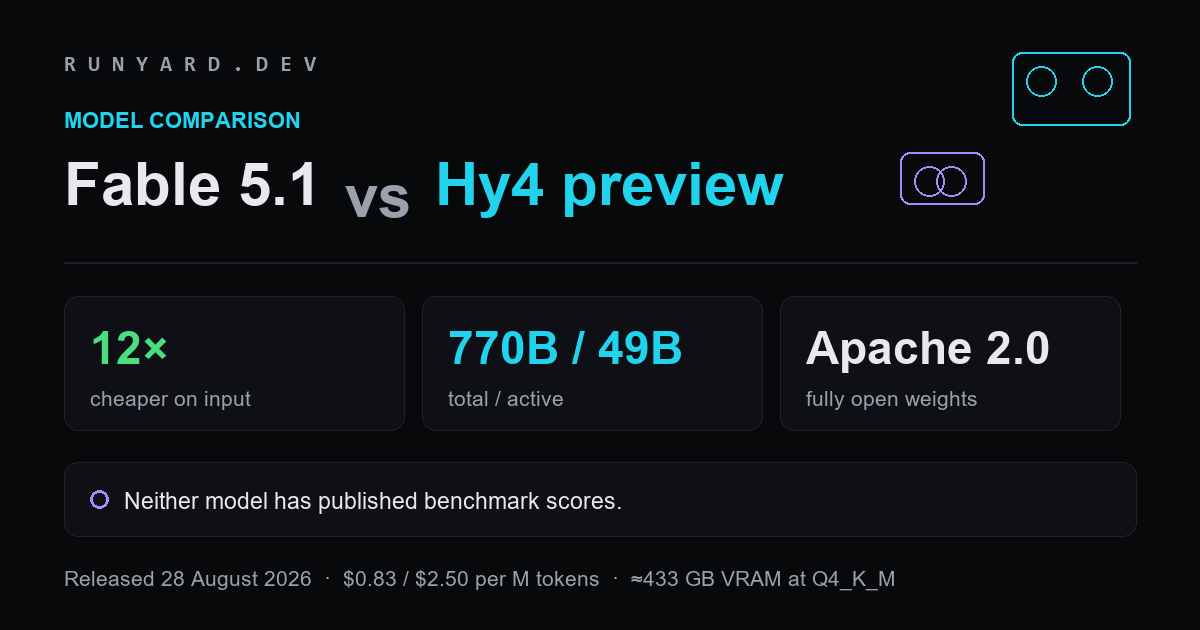
Tencent open-sourced Hy4 preview on 28 August 2026: 770 billion parameters, 49 billion active per token, a million-token context window, and Apache 2.0 weights on Hugging Face. Claude Fable 5.1 arrived four days later with a comparable window, a price cut, and no weights. One of these you can download and modify; the other you can only rent. That is the real axis of this comparison.
What Hy4 preview actually is
It is a mixture-of-experts model with 78 layers: the first uses a dense feed-forward network and the remaining 77 use MoE, each with 256 routed experts plus one shared expert. Every token activates the top eight routed experts along with the shared one, which is how 770 billion total parameters resolve to 49 billion active per token.
The attention design is Gated DeepSeek Sparse Attention with an IndexCache for reusing sparse indices across layers, which is what makes a million-token window tractable to serve. Tencent released the full weights including an FP8 quantised version, under Apache 2.0, on Hugging Face, ModelScope, GitCode and CNB.
There is a genuinely unusual detail in its development: Tencent reports that Hy4 preview was used during its own training to help automate optimisation of the training pipeline, and that it optimised its own inference infrastructure to a measured 31.8% throughput improvement. Whatever weight you give that claim, it is not a marketing line about benchmark scores.
Price, and what it means
Hy4 preview is served at $0.83 per million input tokens and $2.50 per million output. Against Fable 5.1's $10 and $50 — unchanged from Fable 5, since its advertised saving is a cache-read cut rather than a rate cut — that is about twelve times cheaper on input and twenty times on output. It is not the hundredfold gap that GLM-5.3-Flash opens, but it sits in a different tier from Anthropic's pricing.
What the independent benchmarks now show
Neither vendor published benchmarks at launch. Since then the gap between them has opened on the independent side: Artificial Analysis has measured Fable 5.1 at <strong>66</strong> on its Intelligence Index, while Hy4 preview still carries no Artificial Analysis intelligence, coding or agentic index at all. So there is a third-party number for one of these models and none for the other, which is itself worth knowing before you choose.
For reference, Tencent's previous Hy3 preview scored 42.2 on the intelligence index, 58.8 on coding and 31.4 on agentic tasks. Hy4 is a much larger model on a newer architecture, so those figures are a floor rather than a prediction. Treat any confident ranking published this month with suspicion, including ones that favour the model you were already planning to use.
Can you run Hy4 preview yourself?
Legally and practically, yes — but not on a desktop. Apache 2.0 is about as permissive as licensing gets: commercial use, modification and redistribution are all allowed with no revenue thresholds or user caps. That is a meaningfully different position from a hosted model you rent by the token.
The hardware is the constraint. At 770 billion total parameters, every expert must be resident in memory even though only 49 billion are read per token, so the weights need roughly 433 GB at Q4_K_M before any context. The FP8 release helps but does not bring it near a consumer card. What the MoE routing does buy you is speed: it generates at roughly the pace of a 49B dense model, not a 770B one.
- ▸Capacity is set by total parameters — 770B — and that is what fills your memory.
- ▸Throughput is set by active parameters — 49B — and that is why it is faster than its size suggests.
- ▸Apache 2.0 means you can self-host, fine-tune and redistribute without asking permission.
- ▸None of that puts it on a 24 GB card; this is rented-server or owned-cluster territory.
What that price gap is worth on a real workload
Take a concrete case: an agent that reads a medium codebase and writes patches, consuming 200,000 input and 20,000 output tokens per run, invoked 500 times a month. That is 100 million input tokens and 10 million output tokens.
On Fable 5.1 at $10 and $50 per million, that is $1,500 a month before caching. On Hy4 preview at $0.83 and $2.50, the same traffic is about $83 of input and $25 of output, so roughly $108. Call it a fourteenth of the cost. That is not the rounding error a hundredfold gap produces, but it is the difference between a line item you notice and one you do not.
Prompt caching narrows the input side, and it is where Fable 5.1's real price change sits: cache reads cost $0.25 per million rather than $1. On a workload where 90% of input is cached, Fable 5.1's monthly total drops from $1,500 to roughly $620. The gap on cache-heavy work is therefore smaller than the list prices suggest. It does not invert.
Total parameters fill your memory; active parameters set your speed
Mixture-of-experts models are routinely misread on this point, and the error is expensive. The router picks eight of 256 experts per token, so only about 49 billion parameters are read for any given token. But the router can pick any of them, and it changes its mind token by token, so every expert must already be resident. Capacity is set by the 770 billion total; throughput is set by the 49 billion active.
In practice Hy4 preview needs roughly 433 GB at Q4_K_M for weights alone, before context, while generating at roughly the speed you would expect from a 49B dense model. It is cheap to run per token and expensive to hold. Offloading experts to system RAM is possible, and is how people fit MoE models onto smaller machines, but system memory is around an order of magnitude slower than VRAM, and with routing changing every token you pay that penalty constantly rather than occasionally.
weights (GB) = parameters x bits-per-weight / 8

Hy4 preview at Q4_K_M:  770e9 x 4.5 / 8  =  ~433 GB
  ...then add KV cache, which grows linearly with context length
  ...and 49B active is what sets tokens/sec, not the 770B total
The million-token window, and what it costs to use
Hy4 preview and Fable 5.1 both advertise roughly a million tokens of context, and the number is easy to misread as storage. It is not: input tokens are billed on every request rather than kept between them, so filling a 1M-token window once costs about $0.83 on Hy4 preview and about $10 on Fable 5.1 — each time you do it, though a cached re-read on Fable 5.1 is about $0.25.
Self-hosted, the same cost shows up as memory instead of money. KV cache grows linearly with context length, and at long context on a large model it can rival the weights themselves. That is the number that catches people out: a machine sized to hold 433 GB of weights is not sized to hold 433 GB of weights plus a million tokens of cache. Whichever route you take, treat the advertised window as a ceiling to test against rather than a figure to design around.
Fine-tuning: the thing the licence actually unlocks
Apache 2.0 is what makes Hy4 preview interesting beyond its price. You can fine-tune it, deploy the result commercially and redistribute it, with no monthly-active-user threshold or revenue cap of the kind several open-weight licences carry. Fable 5.1 offers none of this at any price, because the weights are not available.
The catch is scale. QLoRA makes fine-tuning dramatically cheaper by quantising the base model to 4-bit and training small adapters on top, which is why an ordinary card can train a model it can barely run. But QLoRA still needs the base model resident, so a 770B model remains a cluster job. If your reason for wanting open weights is that you intend to train on your own data, a 30B-class model you can actually hold is a far better starting point than a 770B model you cannot.
“Preview” is doing real work in that name
Tencent shipped this as a preview, and that is worth taking literally. Preview releases change: quantisations get revised, chat templates get corrected, and recommended serving parameters shift in the weeks after launch. Community tooling — GGUF conversions, runtime compatibility, quantisation quality — lags any release, and a 770B MoE on a novel attention design lags longer than most.
If you are evaluating, that is fine. If you are planning production on it, pin a specific revision and expect to revisit the decision.
So which should you use?
If you need weights you control, Hy4 preview is the only one of the two that is even a candidate, and Apache 2.0 makes it an unusually clean one. If you need a model that runs on hardware you already own, neither qualifies and the question is the wrong one — a 30B-class coding model is the realistic answer.
If you are simply choosing an API for agent work, the decision comes down to reliability per dollar, and neither vendor has given you the numbers to decide it on paper. Run both against your own tasks. A fifteenfold output-price difference gives you a large budget for tolerating a slightly lower completion rate, and a small one for tolerating a materially worse one.
- ▸Cost-sensitive and high-volume: Hy4 preview, at roughly a tenth of the price.
- ▸Need weights you own, can fine-tune and can redistribute: only Hy4 preview qualifies.
- ▸Long agent runs where a failed run costs more than the tokens: test both, trust neither table.
- ▸Need it on hardware you already own: neither — 433 GB is not a desktop number.
- ▸Need published benchmark scores to justify the choice: neither has them yet.
Our <a href="/models">Model Explorer</a> will size either model for self-hosting, the <a href="/lab">lab pages</a> track what each publisher has released, and our <a href="/blog/fable-5-1-vs-fable-5-what-changed">Fable 5.1 breakdown</a> covers the hosted side in more detail. If long context is the draw, read what a <a href="/blog/1m-token-context-window-vram-cost">million-token window costs in VRAM</a> before planning around it.
# Hy4 preview is Apache 2.0 and fully downloadable, including an FP8 build
huggingface-cli download tencent/Hy4-preview --local-dir ./hy4-preview

# 770B total / 49B active: capacity like a 770B model, speed like a 49B one
Tell it your GPU and it ranks every open-weight model that actually fits, with the numbers behind each one.
Open the Model Explorer → →Tools
Find AI models that fit your exact hardware. Enter your specs and get a ranked list instantly.
Newsletter