Contents
Tags
Fable 5.1 vs GLM-5.3-Flash: 143x Cheaper
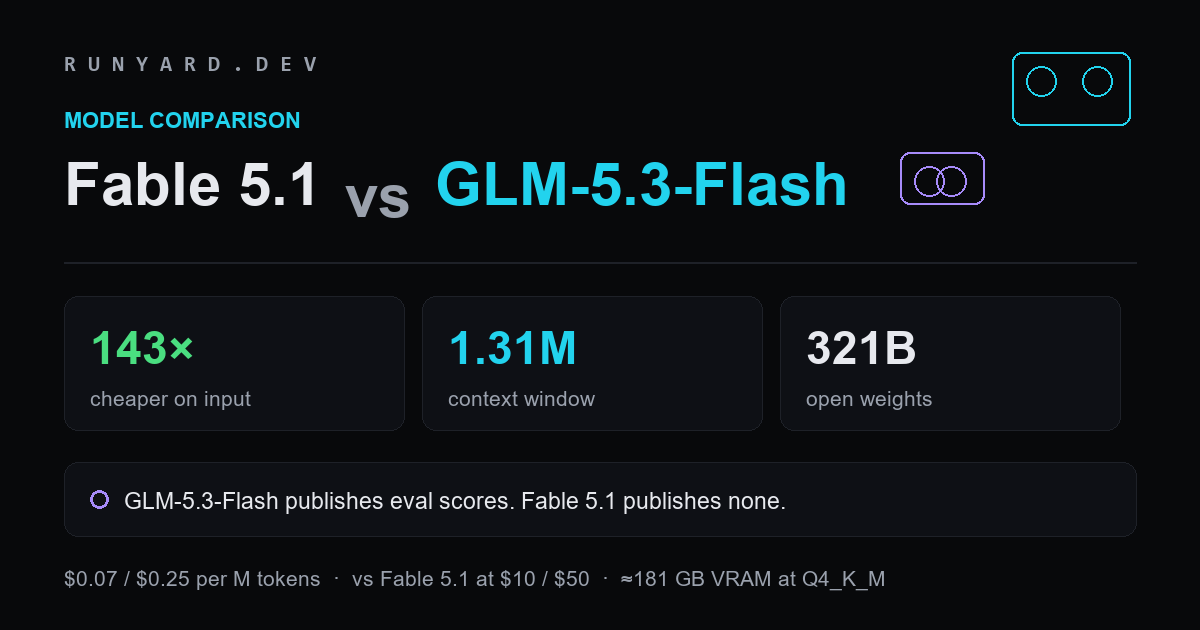
GLM-5.3-Flash costs $0.07 per million input tokens. Claude Fable 5.1 costs $10. That is a 143-fold difference on input and 200-fold on output, and the cheaper model is the one with published benchmark scores and downloadable weights. Here is the comparison in full, including the parts that favour Fable.
The numbers side by side
Fable 5.1 ships a 1 million-token context window with a 128,000-token maximum output. GLM-5.3-Flash, from Z.ai, carries a slightly larger window at roughly 1.31 million tokens. Both are aimed at coding and long-horizon agent work, and both landed within days of each other.
Fable 5.1 lists at $10 per million input and $50 per million output, unchanged from Fable 5. The widely quoted “25% cheaper” figure is a whole-workload saving that comes entirely from cache reads dropping to $0.25 per million, not a cut to the per-token rate. GLM-5.3-Flash is served at $0.07 and $0.25. On output tokens, which dominate most bills, that is a factor of 200.
What GLM-5.3-Flash actually scores
This is where the comparison gets awkward for Fable. GLM-5.3-Flash has published Artificial Analysis scores: 57.5 on the intelligence index, 71.5 on coding and 58.2 on agentic tasks. Anthropic published no benchmark numbers for Fable 5.1 at launch, but Artificial Analysis has since measured it independently at <strong>66</strong> on its Intelligence Index — against GLM-5.3-Flash's 57.5 on the same index. So a comparison does now exist; it just comes from a third party rather than from Anthropic.
That absence is not evidence that Fable 5.1 is weaker. Fable 5 scored 95.0% on SWE-bench Verified, which is a strong result on a different test, and Anthropic's own claim is that 5.1 matches or beats it at lower effort settings. But it does mean anyone publishing a confident head-to-head ranking this week is filling a gap that Anthropic has not filled.
The architecture is worth noting too. GLM-5.3-Flash is natively multimodal and uses a hybrid sparse and linear attention design, which is a large part of how it serves a 1.3M-token window at that price. Sparse attention is the mechanism that makes long context economically viable; it is not a free lunch, but it is the reason the numbers look the way they do.
What a 143-fold difference looks like on a real bill
Percentages get abstract quickly, so take one concrete workload: an agent that reads a medium codebase and writes patches, consuming 200,000 input tokens and producing 20,000 output tokens per run, invoked 500 times a month. That is 100 million input tokens and 10 million output tokens.
On Fable 5.1 at $10 and $50, that is $1,000 of input and $500 of output, so $1,500 a month before any caching. On GLM-5.3-Flash at $0.07 and $0.25, the same traffic costs $7 and $2.50, so under $10. The gap is not a line item you optimise; it is the difference between a budget conversation and a rounding error.
Two things narrow it in practice. Prompt caching cuts the input side sharply, and this is where Fable 5.1's actual price change lives: cache reads cost $0.25 per million rather than $1. If 90% of that 100M input is served from cache, the input bill falls from $1,000 to about $122, and the monthly total from $1,500 to roughly $620. And a model that fails a run wastes the whole run: at these volumes a ten-point difference in completion rate matters more than a tenfold difference in unit price on the failed portion. Neither effect closes a gap that size, but both are real.
Where Fable 5.1 still wins
Agentic reliability is the honest answer. Anthropic's models have a track record on tool-use consistency that the benchmark indexes capture imperfectly, and long agent loops fail in ways that a single-shot coding score does not measure. If your workload is an agent that runs for hours and calls a dozen tools, the price difference matters less than the number of runs that complete.
The 128K maximum output is also unusually high, and matters for tasks that generate large artefacts in one pass. And the cache-read pricing on 5.1 is specifically tuned for agentic reuse, which narrows the effective gap on exactly the workloads where Anthropic expects to be chosen.
There is a second, less discussed advantage: stability of behaviour. A hosted model from a single vendor behaves consistently across every call, whereas a self-hosted open-weight model behaves differently depending on the quantisation, runtime and sampling parameters you happen to have chosen. For teams that need reproducible output more than they need cheap output, that consistency is worth paying for, and it is not captured anywhere in a price table.
The part that actually decides it: you can download one of them
GLM-5.3-Flash publishes its weights on Hugging Face as zai-org/GLM-5.3-Flash. Fable 5.1 does not, and will not. Everything else in this comparison is a number that can change when a provider updates a price list. Weight availability is structural.
What that buys you in practice is the ability to run it somewhere you control, to keep using a specific version after the provider deprecates it, and to fine-tune it on your own data. What it does not buy you is the ability to run it on a gaming PC. At 321 billion parameters, GLM-5.3-Flash needs roughly 181 GB of VRAM for weights alone at Q4_K_M, before any context. That is multi-GPU server territory.
- ▸On a consumer card, neither model is an option: one is closed, the other is too large.
- ▸On rented or owned server GPUs, GLM-5.3-Flash can be self-hosted; Fable 5.1 cannot be, at any budget.
- ▸For most people the realistic choice is which API to call, and there the price gap is the story.
- ▸If you want a model in this class that runs on hardware you own, look at 30B-class coding models instead.
Long context is not free on either model
Both models advertise windows past a million tokens, and both charge for every token you put in them. Filling a 1M-token window once costs about $10 on Fable 5.1 and about $0.07 on GLM-5.3-Flash — though on Fable 5.1 a cached re-read of that same window is about $0.25, which is exactly the case its pricing is built for, because input tokens are billed per request rather than stored between them.
If you self-host instead, the cost moves from your invoice to your memory bus. KV cache grows linearly with context length and is paid in VRAM rather than dollars: on a large model at long context it can rival or exceed the weights themselves. That is why a machine that technically holds a model's weights can still fail the moment you ask for a long conversation, and why context length belongs in your hardware sizing rather than as an afterthought.
- ▸Hosted: long context is a recurring per-call charge, and caching is the only real lever.
- ▸Self-hosted: long context is a one-time VRAM cost that must fit alongside the weights.
- ▸Sparse attention, which GLM-5.3-Flash uses, is what makes serving a 1.3M window affordable.
- ▸Advertised window size and usable window size are different numbers. Test before designing around it.
If neither fits your machine, here is what does
It is worth saying plainly, because most comparisons of this kind quietly imply otherwise: neither of these models is a local-inference option for anyone reading on a desktop. Fable 5.1 is closed, and GLM-5.3-Flash needs roughly 181 GB of VRAM for weights alone at Q4_K_M. A single RTX 5090 has 32 GB. You would need six of them, and then some, before loading a single token of context.
The models that do run on hardware you own are a tier down and a great deal more useful for it. A 32B coding model at Q4_K_M lands near 20 GB, which fits a 24 GB card with room for a working context. A 14B model fits 12 GB comfortably. An 8B model runs on 8 GB with context to spare. None of them match a frontier model on hard reasoning, and all of them are instant, private, and free per token, which for a large share of everyday work is the trade that wins.
- ▸24 GB card: a 32B-class model at Q4_K_M, with usable context.
- ▸16 GB card: a 14B-class model at Q4_K_M, or a 32B at aggressive quantisation and short context.
- ▸12 GB card: a 14B model at Q4_K_M, tightly.
- ▸8 GB card: an 8B model at Q4_K_M, which is a genuinely capable place to start.
- ▸Rule of thumb: a bigger model at Q4 usually beats a smaller model at Q8.
Sampling defaults, if you do self-host
If you run GLM-5.3-Flash on your own infrastructure, the publisher's recommended sampling is a temperature of 1.0 with top_p at 0.95. That is worth honouring before concluding anything about quality: a large share of “this model is worse” reports trace back to sampling parameters carried over from a different model rather than to the weights. Benchmark numbers are produced under the publisher's settings, so a like-for-like comparison has to start there.
Multimodal, and what that changes
GLM-5.3-Flash is natively multimodal, meaning image understanding is built into the model rather than bolted on through a separate vision pipeline. For workloads that read screenshots, diagrams or scanned documents, that removes an integration step and a class of failure. Fable 5.1 handles images too, so this is parity rather than a differentiator for most users — but it matters if you plan to self-host, because a vision pipeline you assemble yourself is considerably more work than one that ships inside the weights.
How to decide without guessing
Run both on your own evaluation set before believing either the price table or the benchmark indexes. A 143-fold price difference is large enough that even a meaningful quality gap can be worth absorbing for high-volume, low-stakes work, and small enough to be irrelevant for a handful of hard requests a day where a failed run costs more than the tokens.
- ▸High volume, tolerant of the occasional retry, cost-sensitive: GLM-5.3-Flash, comfortably.
- ▸Long autonomous agent runs where a failure costs more than the tokens: test Fable 5.1 first.
- ▸You need the weights — for compliance, version pinning or fine-tuning: only GLM-5.3-Flash qualifies.
- ▸You need it to run on a card you own: neither, so look at a 30B-class coding model instead.
- ▸You need published benchmark numbers to justify the choice internally: only GLM-5.3-Flash has them.
If you are weighing self-hosting, start from what your hardware can hold. Our <a href="/models">Model Explorer</a> sizes any model at any quantisation, the <a href="/gpu">GPU pages</a> list what each card runs, and our <a href="/blog/fable-5-1-vs-fable-5-what-changed">breakdown of the Fable 5.1 release</a> covers what changed on the hosted side. For the long-context question specifically, see what a <a href="/blog/1m-token-context-window-vram-cost">1M-token window costs in VRAM</a>.
# GLM-5.3-Flash weights are public, but 321B needs server-class hardware
huggingface-cli download zai-org/GLM-5.3-Flash --local-dir ./glm-5.3-flash

# Publisher-recommended sampling for GLM-5.3-Flash
#   temperature 1.0, top_p 0.95
Tell it your GPU and it ranks every open-weight model that actually fits, with the numbers behind each one.
Open the Model Explorer → →Tools
Find AI models that fit your exact hardware. Enter your specs and get a ranked list instantly.
Newsletter