Contents
Tags

Fable 5.1 vs Fable 5: What Changed and What It Costs
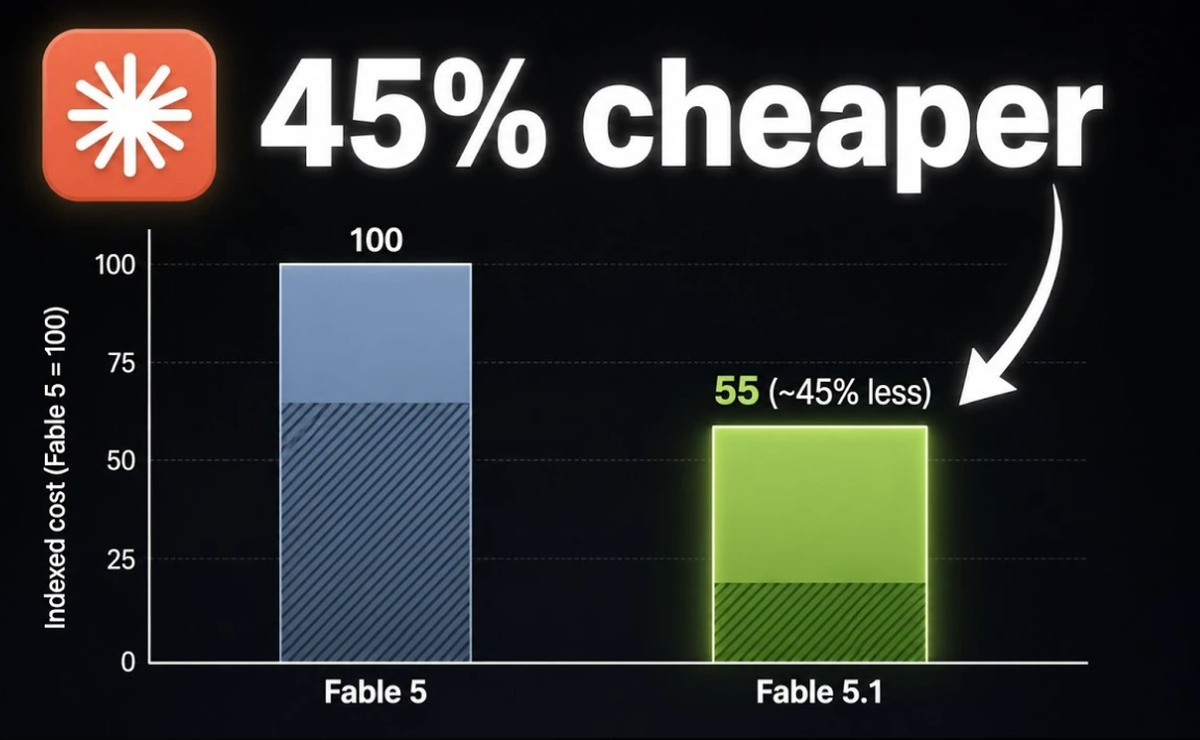
Anthropic shipped Claude Fable 5.1 on 1 September 2026, alongside a restricted sibling called Mythos 5.1. The headline is not a benchmark — it is a price cut. Fable 5.1 is billed at roughly 25% less than Fable 5 for typical workloads and up to 45% less for heavily agentic ones, and Anthropic has not published a head-to-head benchmark table to go with it. Here is what is actually confirmed, what is not, and how the new pricing compares against running an open-weight model on your own GPU.
What is confirmed about Fable 5.1?
Four things are stated plainly by Anthropic and corroborated across launch coverage. Fable 5.1 is generally available as of 1 September 2026. It carries a 1 million-token context window with a 128,000-token maximum output. It costs about 25% less than Fable 5 for typical workloads, rising to roughly 45% cheaper on highly agentic work. And a large part of that saving comes specifically from cheaper cache reads — the reprocessing of context you have already sent.
Anthropic's own framing is that the model "achieves similar or better results than Fable 5 at a much lower cost" when run at low or medium effort. That is a claim about cost-efficiency at reduced reasoning budgets, not a claim of a raw capability jump, and it is worth reading precisely because the distinction matters for what you should do about it.
Mythos 5.1 launched at the same time and is, by Anthropic's account, the same underlying model. The difference is its safeguards: it is limited to trusted-access programmes for cybersecurity and life-sciences work. If you are comparing options as a general developer, Mythos is not on your menu.
What has not been published?
No head-to-head benchmark table. At launch there was no SWE-bench Verified score, no SWE-bench Pro score and no agentic benchmark result published for Fable 5.1 specifically. Anyone presenting a precise 5.1 benchmark figure this week is either quoting Fable 5's numbers or estimating.
For reference, the published Fable 5 baseline is 95.0% on SWE-bench Verified and 80.3% on SWE-bench Pro. Claude Opus 5 sits at 96.0% and 79.2% on the same two tests. Those are Fable 5's numbers, not 5.1's, and they are the honest comparison point until Anthropic publishes more.
Fable 5.1 is deliberately absent from that chart. It has no published SWE-bench figure yet, and inventing one would be worse than leaving the gap visible.
How much does the price cut actually save?
Fable 5 is priced at $10 per million input tokens and $50 per million output tokens. Those per-token prices are unchanged in Fable 5.1. The saving does not come off the input or output rate at all: it comes entirely from cache reads, which drop to $0.25 per million tokens, 75% below Fable 5's $1, with agentic workloads that reuse large cached contexts saving more because the discount is weighted towards cache reads.
That is a real reduction, and for anyone whose bill is dominated by long system prompts or repeated document context, the cache-read change is the part worth modelling. It is also the part most likely to be mispriced in a quick estimate, because it depends on how much of your context is genuinely reused between calls rather than sent fresh.
What does "low or medium effort" actually mean here?
Anthropic's efficiency claim is scoped to effort settings, and that scoping is the most commercially important sentence in the announcement. Effort controls how much reasoning the model spends before answering. Higher effort means more internal tokens, better results on hard problems, and a larger bill; lower effort means the opposite.
Saying 5.1 matches or beats Fable 5 "at low or medium effort" is therefore a claim that you can dial the reasoning budget down and keep the quality you were getting before. If true for your workload, the saving compounds with the headline price cut, because you are paying less per token and generating fewer of them. If your work sits at the hard end where high effort earns its keep, the same sentence tells you rather less.
The practical consequence is that you should not accept the 25% figure as your number. Re-run your own evaluation set at low and medium effort on 5.1, compare against whatever effort level you were using on Fable 5, and measure the two things that actually move your bill: tokens consumed and pass rate. A model that is cheaper per token but needs two attempts is not cheaper.
Why the cache-read discount matters more than the headline
Most of the saving is weighted towards cache reads rather than fresh input, and that detail decides whether you see 25% or something closer to 45%. Cached reads are what you pay when a request re-sends context the provider has already processed — a long system prompt, a codebase excerpt, a document held across a conversation.
Workloads differ enormously here. A chat product that sends a short prompt and a couple of turns reuses very little, and will see something near the lower end of the range. An agentic loop that carries a large tool schema and a working set through dozens of steps reuses almost everything, which is exactly why Anthropic quotes up to 45% for that shape of work. Before budgeting, measure what fraction of your input tokens are genuinely cached rather than assuming an average.
Does a cheaper API change the case for running models locally?
Less than the headline suggests, because the two costs are not the same kind of cost. Hosted inference is a per-token operating expense that falls whenever a provider cuts prices. Local inference is mostly a capital cost — the card — plus electricity, and the electricity component is small enough that it rarely drives the decision.
Generating a million tokens on an RTX 4090 at around 40 tokens per second takes roughly seven hours and draws about 3.1 kWh, which is well under a dollar at typical residential rates. The reason to run locally has never been that it beats an API on marginal cost at low volume. It is that the marginal cost is nearly flat, the data never leaves the machine, and nobody can deprecate the model out from under you.
What a 25% price cut does change is the break-even volume. If you were close to the line on a GPU purchase justified purely by token spend, the line just moved further away. If you were buying for privacy, offline capability, or control over a specific fine-tune, nothing about this release affects that calculation.
Which open-weight models are in the same conversation?
If the appeal of Fable 5.1 is coding and long-context work, the open-weight releases worth measuring against it are Qwen3-Coder, DeepSeek V4 and GLM-5.3 — all of which you can run on hardware you own, at quantisations that fit consumer cards. We have written up the hardware fit for several of them, including <a href="/blog/how-to-run-deepseek-v4-flash-locally">how to run DeepSeek V4 Flash locally</a> and a <a href="/blog/glm-5-2-vs-deepseek-v4-vs-kimi-k3-hardware-fit">three-way hardware-fit comparison</a> across GLM, DeepSeek and Kimi.
- ▸Long context is the closest like-for-like: several open-weight models now ship 128K-1M windows, though the KV cache cost of actually using them is real and grows with your context length.
- ▸Coding is where open weights have closed the most ground, and where a 30B-class model on a 24 GB card is genuinely usable day to day.
- ▸Agentic loops are where hosted models still hold an advantage, because tool-use reliability degrades faster than raw generation quality when you quantise.
How do I work out which of these I can actually run?
Start from the card, not the model. The number that decides everything is VRAM: weights at your chosen quantisation, plus the KV cache for your context length, plus about a gigabyte of runtime overhead. A model that does not fit will still load by offloading layers to system RAM, but system memory is roughly an order of magnitude slower than VRAM, so throughput collapses and the experience stops being worth having.
Our <a href="/models">Model Explorer</a> does that arithmetic for any model and quantisation, and the <a href="/compare">comparison view</a> puts open-weight candidates side by side on the hardware you actually own. If you would rather work backwards from a card you already have, the <a href="/gpu">GPU pages</a> list what each one runs and how fast.
# A rough local equivalent for coding work, running entirely on your own GPU
ollama run qwen3-coder

# Or with llama.cpp for control over context and offloading
llama-server -m qwen3-coder-Q4_K_M.gguf \
  --n-gpu-layers 999 \
  --ctx-size 32768 \
  --host 127.0.0.1 --port 8080
So should you switch?
If you already use Fable 5 through the API, 5.1 is a straightforward upgrade: same family, lower bill, and Anthropic's own guidance is that low and medium effort settings now reach comparable results. Re-run your evaluations at those settings before assuming the saving is free, because that is precisely where the claim is scoped.
If you are weighing hosted against local, treat this as a repricing rather than a capability shift. The right question is still which models your hardware can hold, and that answer has not moved. Nothing in this release makes a 24 GB card hold more.
Tell it your GPU and it ranks every open-weight model that actually fits, with the numbers behind each one.
Open the Model Explorer → →Tools
Find AI models that fit your exact hardware. Enter your specs and get a ranked list instantly.
Newsletter