Contents
Tags

Claude Fable 5.1 Is Ranked #1. That Means Less Than You Think
Claude Fable 5.1 currently holds the highest published score on Artificial Analysis's Intelligence Index, at 66. It is a genuine result and it is worth taking seriously. It is also one number standing in for nine, produced under one specific set of conditions, and the gap between “ranked first overall” and “best model for your work” is wider than most coverage admits. Here is what is actually underneath the ranking.
What the Intelligence Index actually is
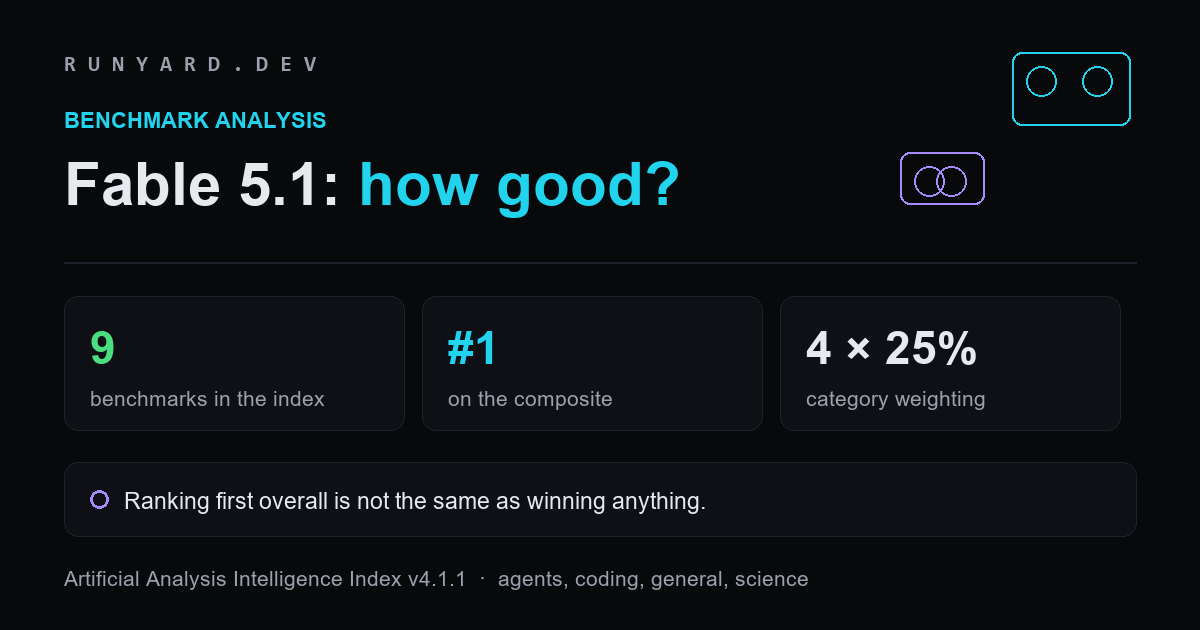
Artificial Analysis's Intelligence Index, currently at version 4.1.1, is a weighted average of nine evaluations, scaled 0 to 100. The nine are GDPval-AA v2, τ³-Banking, Terminal-Bench v2.1, SciCode, Humanity's Last Exam, GPQA Diamond, CritPt, AA-Omniscience and AA-LCR.
Those nine are grouped into four categories — agents, coding, general capability and scientific reasoning — each contributing 25% of the final number. So a model can lead the composite while placing mid-table on several of its components, provided it is strong enough in the others to carry the average.
Artificial Analysis is explicit about this in its own methodology: a higher score indicates stronger aggregate performance across the suite, but individual benchmark results may be more relevant for specific use cases such as coding, agentic workflows, factuality or scientific reasoning. The headline is a summary, and the publisher says so.
Why a composite can mislead you specifically
The failure mode is straightforward. If your work is scientific reasoning, the quarter of the index covering scientific reasoning is the part that describes you, and the other three quarters are noise dragging the number toward or away from your reality. Two models separated by three points on the composite might be separated by fifteen on the component you actually care about, in either direction.
This is not a criticism of the index, which is doing exactly what a composite is supposed to do. It is a criticism of how composites get read. A single number is what gets into headlines and what gets quoted in procurement discussions, and it is the least informative view of the underlying data.
- ▸Ask which of the four categories matches your workload, and weight that one.
- ▸Check whether the model leads its category or merely does not lose it.
- ▸Treat a gap of one or two points on a 0–100 composite as noise unless you know which components produced it.
- ▸A model that wins on average can lose on your task; the reverse is equally true.
The harness problem, which is bigger than the index problem
Here is the part that genuinely complicates model comparison in 2026: most people no longer use a model directly. They use it inside a harness — Claude Code, Codex, Cursor, Cline, or a loop they wrote themselves. The harness controls context management, retries, tool definitions, and how much of the previous turn survives into the next one. It can move results by more than a model upgrade does.
Artificial Analysis's Coding Agent Index acknowledges this directly: it measures combinations of harness and model rather than models alone, combining DeepSWE, Terminal-Bench v2.1 and SWE-Atlas-QnA. That is why the leading entry reads as “Fable 5.1 in Claude Code” at 70, rather than simply “Fable 5.1”, and why GPT-6 Astra's 67 is really “Astra in Codex”.
The practical consequence is that a harness-inclusive score transfers to your setup only insofar as your setup resembles the one tested. If you run Fable 5.1 through your own agent loop rather than Claude Code, the 70 is not your number. It might be better; it is more often worse, because vendor harnesses are tuned for their own models.
How much can plumbing actually move a score?
More than most people would guess, and there is now a clean public demonstration of it. When ARC Prize evaluated GPT-6 Astra on ARC-AGI-3, the same model scored <strong>62.7% on the provider-neutral standard harness</strong> and <strong>99.9% on a provider-adapter harness</strong> built to use OpenAI's native context-management features, which preserve opaque reasoning state between requests and compact longer conversations.
Same weights, same benchmark, same questions. The rig changed. Both numbers are real, and quoting either without the other misrepresents the model. That is the clearest available evidence that when someone tells you a model scores X, the correct follow-up question is “in what?”
It follows that comparing a score from one leaderboard against a score from another for the same named benchmark is usually invalid. Different harnesses, different repeat counts, different time budgets and different sandboxes all move results, and two organisations measuring “the same” benchmark routinely publish numbers that are several points apart for legitimate reasons.
So is Fable 5.1 good?
Yes, on the evidence available. It holds the top published Intelligence Index score at 66, and the top Coding Agent Index score at 70 in Claude Code. Two independent composites, both first. That is not nothing, and it is more than any competitor can currently claim.
What it does not establish is that Fable 5.1 is the best model for your workload, that the margin is large, or that it will hold once you swap the harness. Anthropic also published no benchmark table of its own at launch, which means every number in this discussion is a third-party measurement rather than a vendor claim — a point in its favour for credibility, and a reason the independent methodology deserves scrutiny.
The subscription layer, where rankings matter least
Most people never touch the API, and on a subscription the ranking becomes even less predictive of experience. What decides whether a model feels good on a plan is how quickly it consumes your allowance, and that is a function of verbosity and reasoning depth rather than of index position.
A model that reasons deeply and writes at length can top a benchmark while emptying a five-hour window in a single agentic session — a pattern developers reported repeatedly with the Fable line. The index does not measure tokens consumed per task, so a model can rank first and still be the wrong choice for someone on a fixed plan doing high-volume work.
If you are on a subscription rather than the API, the number worth watching is not the leaderboard position but how much of your allowance one representative task consumes. That is measurable in an afternoon and tells you more than any composite.
The price question the ranking does not answer
Fable 5.1 lists at $10 per million input tokens and $50 per million output, matching GPT-6 Astra and sitting roughly seven times above GLM-5.3 and over a hundred times above GLM-5.3-Flash. Ranking first on a composite index says nothing about whether the gap justifies the multiple for the work you do.
On the evidence, the honest position is that the top of the market is now separated by a few points on composites that are themselves averages of nine imperfect tests measured through one harness. The models below it are separated from the top by a similar handful of points and a factor of a hundred in price. Whether that is worth paying is a question about your workload, not about the leaderboard.
What to do instead of reading rankings
- ▸<strong>Build a twenty-task evaluation set from your real work.</strong> It will tell you more in an afternoon than any index, because it weights the categories the way you do.
- ▸<strong>Measure completions, not scores.</strong> For agentic work, the fraction of runs that finish correctly is the only metric that maps to value.
- ▸<strong>Count tokens per completed task.</strong> This is where identically priced models diverge, and it never appears on a pricing page.
- ▸<strong>Test in your harness.</strong> A published score measured in a vendor's own agent does not describe your loop.
- ▸<strong>Re-tune effort before switching model.</strong> A large share of apparent capability gaps turn out to be a default setting nobody adjusted.
For the specific head-to-heads, see <a href="/blog/gpt-6-astra-vs-fable-5-1">Astra against Fable 5.1 at identical prices</a> and <a href="/blog/fable-5-1-vs-opus-5">Fable 5.1 against Claude Opus 5</a>, which costs half as much and leads on Anthropic's own published tests.
And if the conclusion is that much of your workload does not need a frontier model at all — which is the usual conclusion once people measure — our <a href="/models">Model Explorer</a> ranks the open-weight models that fit your hardware and cost nothing per token.
Tell it your GPU, RAM and backend, and it ranks every open-weight model that actually fits your machine.
Open the Model Explorer → →Tools
Find AI models that fit your exact hardware. Enter your specs and get a ranked list instantly.
Newsletter