Contents
Tags
Claude Code vs Codex vs Cursor: The Harness Is Worth More Than the Model
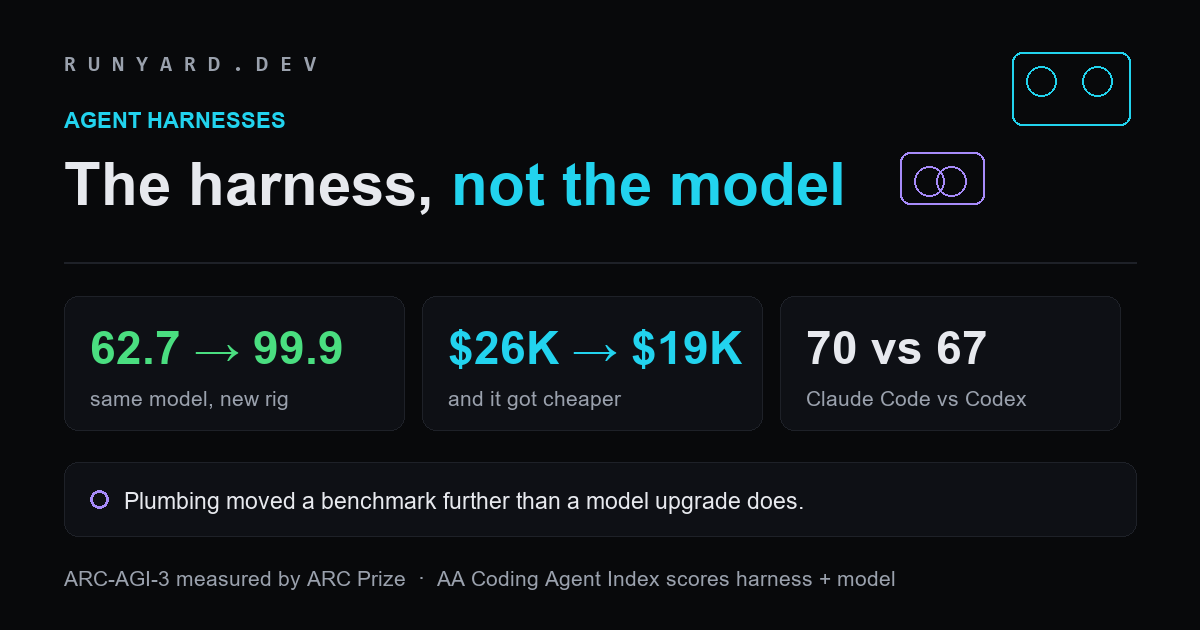
In September 2026, ARC Prize published two scores for GPT-6 Astra on ARC-AGI-3. One was 62.7%. The other was 99.9%. Same model, same benchmark, same week. The only thing that changed was the harness around the model — and the higher score also cost less to produce. If you are choosing between Claude Code, Codex and Cursor, that single data point should reorder your priorities.
What a harness actually does
A harness is everything between you and the raw model: the agent loop, tool definitions, retry logic, and above all context management. It decides what the model sees on turn seventeen, which is a far more consequential decision than most people treat it as.
- ▸<strong>Context assembly.</strong> Which files, which prior turns, which tool outputs make it into the next request, and in what order.
- ▸<strong>State carrying.</strong> Whether reasoning from previous turns survives, is summarised, or is thrown away and rebuilt from scratch.
- ▸<strong>Compaction.</strong> What happens when the conversation outgrows the window — a lossy summary, a structured set of notes, or a hard truncation.
- ▸<strong>Tool surface.</strong> How many tools, how they are described, and whether the model is encouraged to batch independent calls or issue them one at a time.
- ▸<strong>Retries.</strong> Whether a failed step ends the run or is retried with context about why it failed.
None of that is the model. All of it changes the model's output.
The evidence: 62.7% versus 99.9%
ARC Prize evaluated GPT-6 Astra on the ARC-AGI-3 semi-private set twice. On their <strong>standard, provider-neutral harness</strong> it scored <strong>62.7%</strong> at a compute cost of $26,098. On a <strong>provider-adapter harness</strong> built to use OpenAI's native context-management features — preserving opaque reasoning state between requests and compacting longer conversations — the same model scored <strong>99.9%</strong> at $18,817.
Two things about that deserve emphasis. First, the gap is 37 percentage points from plumbing alone, which is larger than the gap between most consecutive model generations. Second, the better score was <em>cheaper</em>: $18,817 against $26,098. Carrying state properly meant the model rebuilt less work on every call.
That inverts the usual assumption that better results come from spending more compute. Here the win came from not wasting it, and the mechanism was entirely in the harness.
Why published scores name a harness
Artificial Analysis's Coding Agent Index is built around this reality: it measures combinations of harness and model rather than models in isolation, combining DeepSWE, Terminal-Bench v2.1 and SWE-Atlas-QnA into one score.
That is why the leading entry reads as <strong>Fable 5.1 in Claude Code at 70</strong> rather than simply “Fable 5.1”, and why GPT-6 Astra's 67 is really “Astra in Codex”. Those numbers describe two complete systems. Swap either component and you have a different system with a different score.
The practical consequence is uncomfortable for anyone doing procurement by leaderboard: a three-point difference between two harness-plus-model combinations tells you very little about how those models would compare inside <em>your</em> harness.
How to choose between Claude Code, Codex and Cursor
Since the harness carries real weight, choose it deliberately rather than by whichever model you wanted. Four questions decide it in practice.
- ▸<strong>Does it carry state well?</strong> The ARC result says this is the highest-leverage property. A harness that compacts intelligently rather than truncating will outperform one that does not, on the same model.
- ▸<strong>Is it tuned for the model you want?</strong> Vendor harnesses are optimised for their own models, which is part of why Claude Code plus Fable 5.1 and Codex plus Astra both score well. A third-party harness is more neutral and sometimes leaves capability on the table.
- ▸<strong>Does it let you change effort?</strong> Reasoning effort is a direct multiplier on cost and quality. A harness that pins it removes your cheapest lever.
- ▸<strong>Can it batch tool calls?</strong> Models vary in how reliably they batch independent calls, and a harness that prompts for batching recovers turns, tokens and wall-clock time.
Notice that none of those are about which model the harness defaults to. Model choice is reversible in a config line; harness behaviour is what you actually live with.
Where harness choice matters least
It would be an overcorrection to conclude that models no longer matter. The harness effect is largest on long, multi-turn, tool-heavy work, because that is where context management compounds. It shrinks toward nothing on single-turn tasks.
If you are asking one question and reading one answer, there is no state to carry, no compaction to get wrong and no tool loop to batch. The model is doing essentially all of the work, and model choice is the whole decision. The same is true of classification, extraction and short generation at volume.
So the rule of thumb is proportional: the longer your agent runs and the more tools it touches, the more the harness decides your outcome, and the less a leaderboard position measured in someone else's harness tells you.
What this means for your own agent loop
If you have written your own loop, the ARC numbers are an argument for spending a week on context management before spending anything on a better model. Concretely: carry structured notes across turns rather than a lossy summary, avoid rebuilding reasoning the model already did, keep the conversation append-only so prompt caching keeps matching, and prompt explicitly for batched tool calls.
Each of those is free. Together they can move results by more than a model upgrade that doubles your token price. Most teams have the ratio backwards, spending heavily on model comparison and almost nothing on the layer that the evidence says matters more.
Why vendor harnesses score well with vendor models
There is a pattern in the published Coding Agent Index results that is worth naming: the top entries pair a vendor's harness with that vendor's model. Fable 5.1 in Claude Code leads at 70; Astra in Codex reaches 67. That is not a coincidence and it is not necessarily favouritism either.
A vendor knows things about its own model that a third party cannot easily exploit: how it responds to particular tool-call formats, how its reasoning state can be preserved between requests, what its compaction tolerates. The ARC-AGI-3 provider-adapter result is exactly this effect measured in isolation — the adapter existed specifically to use OpenAI's native context-management features.
The practical implication cuts both ways. If you are committed to one vendor's model, its own harness is likely to extract more from it than a neutral tool will. If you want to switch models freely, a neutral harness costs you some peak performance and buys you portability. Neither is wrong; they are different bets, and the size of the trade is measurable on your own tasks in an afternoon.
How to actually compare them
Published harness-plus-model scores are a starting point, not an answer for your setup. The test that answers your question is small.
- ▸Take twenty representative tasks from your real work.
- ▸Run them across the harnesses you are considering, holding the model constant.
- ▸Then hold the harness constant and vary the model.
- ▸Compare the size of the two effects. If the harness effect is larger — and on agentic work it often is — you now know where to spend your attention.
- ▸Measure completion rate and tokens per completed task, not subjective quality.
For the model side of the same question, see our <a href="/blog/gpt-6-astra-vs-fable-5-1">Astra against Fable 5.1 comparison</a> and <a href="/blog/fable-5-1-is-it-really-that-good">what a number-one benchmark ranking actually means</a>. For the cost side, <a href="/blog/cost-per-task-vs-cost-per-token">cost per task beats cost per token</a> explains why token counts move more than prices do.
And if a chunk of your agent's work turns out not to need a frontier model, the harness question applies equally to local models — the same loop, pointed at weights you own. Our <a href="/models">Model Explorer</a> ranks what runs on your machine.
Tell it your GPU, RAM and backend, and it ranks every open-weight model that actually fits your machine.
Open the Model Explorer → →Tools
Find AI models that fit your exact hardware. Enter your specs and get a ranked list instantly.
Newsletter